Dysgraphia vs dyspraxia: how to tell them apart in kids
Dysgraphia is a difficulty with writing itself: forming letters, spacing them, and getting thoughts onto paper. Dyspraxia, now called developmental coordination disorder (DCD), is a difficulty with movement in general, so it shows up in shoelaces, ball games and cutlery as well as handwriting. Messy writing alone doesn't tell you which one a child has. What the child does away from the page does.
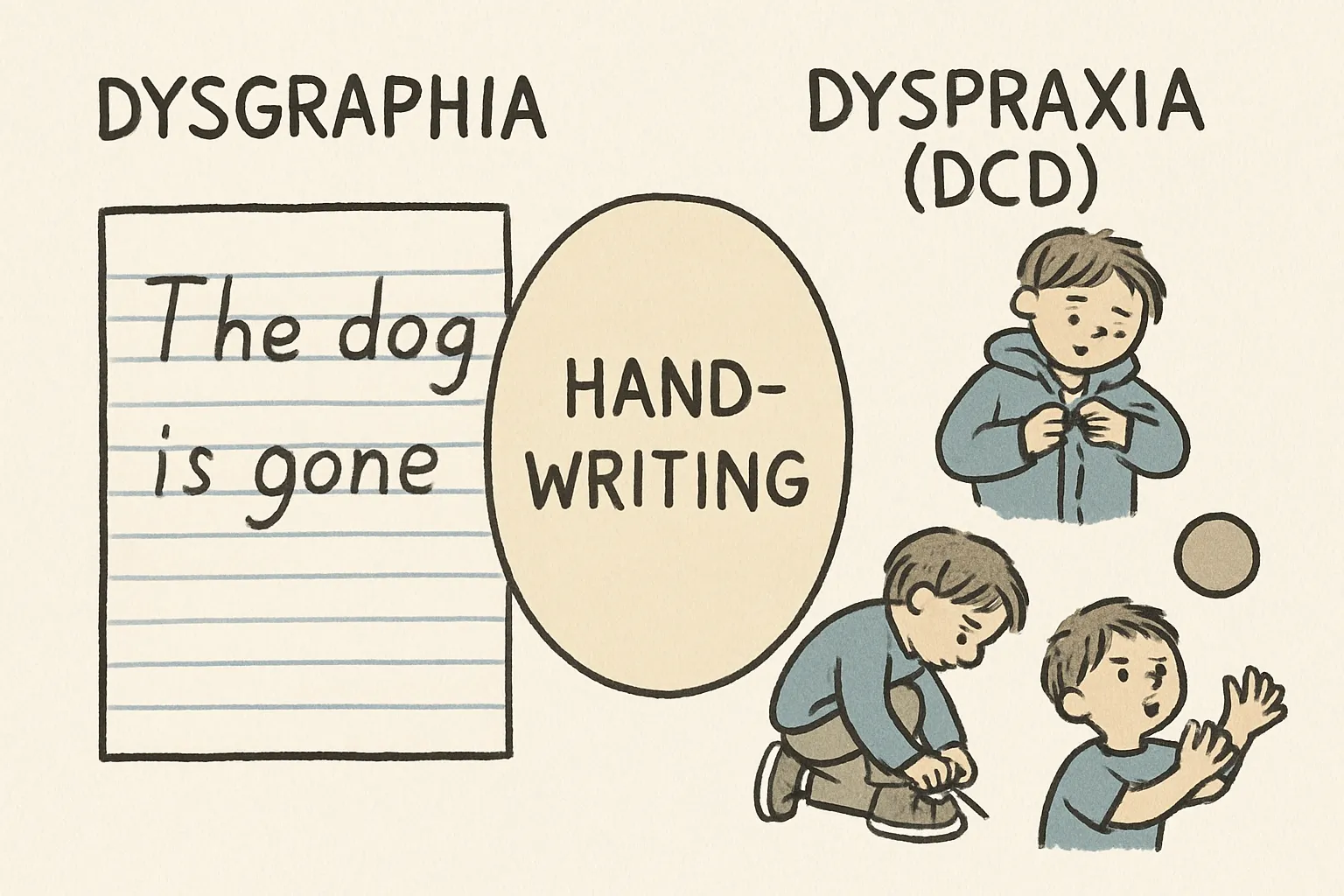
Both words get used for the child whose writing looks like it fell down the stairs. They aren't the same thing. Dysgraphia is about writing. Dyspraxia is about movement, and writing is one of the many movements it touches.
The numbers tell you how common the second one is. The 2019 international guidelines on developmental coordination disorder, written by a panel for the European Academy of Childhood Disability and published by Rainer Blank and colleagues, put the most quoted figure at 5 to 6 percent of children. That's one or two kids in a class of 30. Boys are diagnosed two to seven times as often as girls.
What is the difference between dysgraphia and dyspraxia?
Dysgraphia is trouble with written language: letter shapes, spacing, speed, and turning ideas into sentences. Dyspraxia is trouble planning and coordinating movement across the whole body. A child with only dysgraphia can often catch a ball and do up buttons without fuss. A child with dyspraxia struggles with those too, and handwriting is one more motor task on the list.
Understood.org, the US learning-differences nonprofit, draws the line the same way. Its comparison lists bumping into things, dropping things, trouble with zips and utensils, and late hand dominance under dyspraxia. Under dysgraphia it lists letter formation, unreadable writing, slow and effortful writing, odd spacing, and run-on sentences with no paragraph breaks. Both lists include holding the pencil awkwardly. That's where parents get stuck.
Is dyspraxia the same as developmental coordination disorder?
Yes, near enough. Developmental coordination disorder is the medical name, and it's the one a pediatrician or occupational therapist will write down. The 2019 international consensus went further and advised against using "dyspraxia" at all, because the word means different things in different countries. In the UK it's still the everyday term, and the NHS lists the condition under both names.
Dysgraphia has a naming problem of its own. The DSM-5, the US diagnostic manual, doesn't use the word. A psychologist will write "specific learning disorder with impairment in written expression," which covers spelling, grammar and punctuation, and how clearly a child organizes writing. Handwriting that's poor because of motor coordination points toward DCD instead. So two children with the same messy page can come home with two different labels, depending on what's underneath.
Signs to compare at home
Watch your child for a week, away from homework. You're looking for whether the trouble stays at the table.
Signs that point toward dysgraphia:
- Letters are formed differently each time, even after a lot of practice.
- Writing is slow and tiring, but cutting, building and sports are about average.
- Spelling and sentence building fall apart when the child also has to handle the pencil.
- The child can tell you a great story out loud and writes two thin lines of it.
Signs that point toward dyspraxia (DCD):
- Dressing takes ages: buttons, zips, and laces most of all.
- Ball skills, bike riding or hopping came late or still look awkward.
- Spills at meals, trouble with a knife and fork, and bumping into furniture.
- Crawling, walking or feeding came later than for siblings or classmates.
- Copying from the board is hard, and so are scissors and drawing.
If you're ticking boxes in both lists, that's common. The two overlap, and Understood.org notes that dysgraphia often shows up alongside dyspraxia or dyslexia. The Blank guidelines also list ADHD, language disorder, learning disorders and autism among the conditions that come with DCD.
Who diagnoses dysgraphia and dyspraxia?
Different people, which is part of the confusion. DCD is a medical diagnosis, made by a pediatrician or a doctor working with an occupational therapist who runs a standard motor test. Dysgraphia, as a learning disorder, is usually identified by a school or educational psychologist through written-language testing. One evaluation can point you to the other.
For DCD, the most common test is the Movement Assessment Battery for Children, second edition (MABC-2). It looks at hand skills, ball skills and balance. Canadian DCD toolkits for clinicians use a score at or below the 16th percentile as a flag for children 6 and over. The Blank guidelines say a firm diagnosis before age 5 should be kept for severe cases and needs two assessments at least three months apart. The NHS gives the same picture: signs show early, diagnosis waits until about 5.
For handwriting itself, therapists use separate tools. The international guidelines name the Detailed Assessment of Speed of Handwriting (DASH) and the Handwriting Proficiency Screening Questionnaire. The International Dyslexia Association's dysgraphia fact sheet points to Berninger's PAL-II reading and writing battery and Milone's Test of Handwriting Skills.
In the US, a learning disorder in written expression can qualify a child for special education services under IDEA, the federal special education law. A child with DCD whose writing is affected can often get classroom accommodations under a 504 plan. Ask the school in writing for an evaluation. A written request starts the clock.
Does the treatment differ?
Less than you'd think. Both respond best to direct practice of the actual skill, broken into small steps. For DCD, the Blank guidelines give their strongest rating to activity-based approaches such as task-specific training, Neuromotor Task Training and CO-OP, where the child learns to plan and check their own movements. They don't recommend sensory integration therapy, because the evidence for it is inconclusive.
For handwriting problems, the same guidelines recommend practicing the writing itself, with ways for the child to judge their own letters. They also say keyboard skills should be taught alongside handwriting from early on, not held back as a last resort.
The International Dyslexia Association fact sheet makes the dysgraphia side concrete. Children need explicit, step-by-step teaching of letter formation. Accommodations on their own are not enough. Young children start with clay, mazes, dot-to-dots, tracing and copying. Later steps include letters with numbered arrows showing stroke order, covering a letter with a card and writing it from memory, and writing letters to dictation until they come out automatically.
That's work you can start at home before any appointment. It won't do harm if the label turns out to be something else.
What to do while you wait for an evaluation
- Keep a short log for two weeks: what took a long time, what got avoided, what went fine. Bring it to the appointment. Clinicians ask for examples, and parents forget them.
- Save three writing samples, dated, from different days. Include one copied and one written from memory.
- Keep writing practice short. Five minutes a day beats a 30-minute battle, and a tired hand practices bad habits.
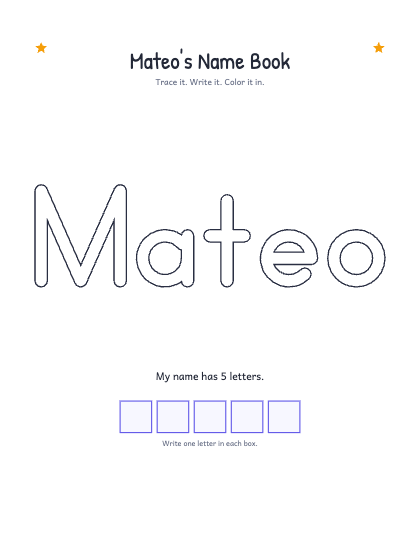
- Trace before you copy. Print a page of your child's name or a few tricky letters on the name tracing generator, with the starting dots and arrows shown, and let them trace three times before trying it freehand.
- Use three-line paper with a dashed midline so letter sizes have somewhere to sit.
- Add one hand-strength game a day, like pinching clothespins onto a box edge or rolling clay snakes. Our fine motor activities guide lays out a 15 minute home routine.
- Start keyboard play at 7 or 8 if writing is slow. It doesn't replace handwriting, but it lets a child's ideas out while the hand catches up.
If your child has started to refuse writing, read the refusal guide first. Fixing the fear comes before fixing the letters.
Make a name tracing worksheet
Type a name, pick a font, and print a free tracing sheet to practise with.