How to hold a pencil the right way
Hold the pencil at three points: pinch it between the thumb and index finger, and rest it on the side of the middle finger. That is the tripod grip, and most kids settle into it between ages 4 and 7. Three other adult holds work equally well, so what matters more than the shape is that the fingers do the moving and the hand does not hurt.
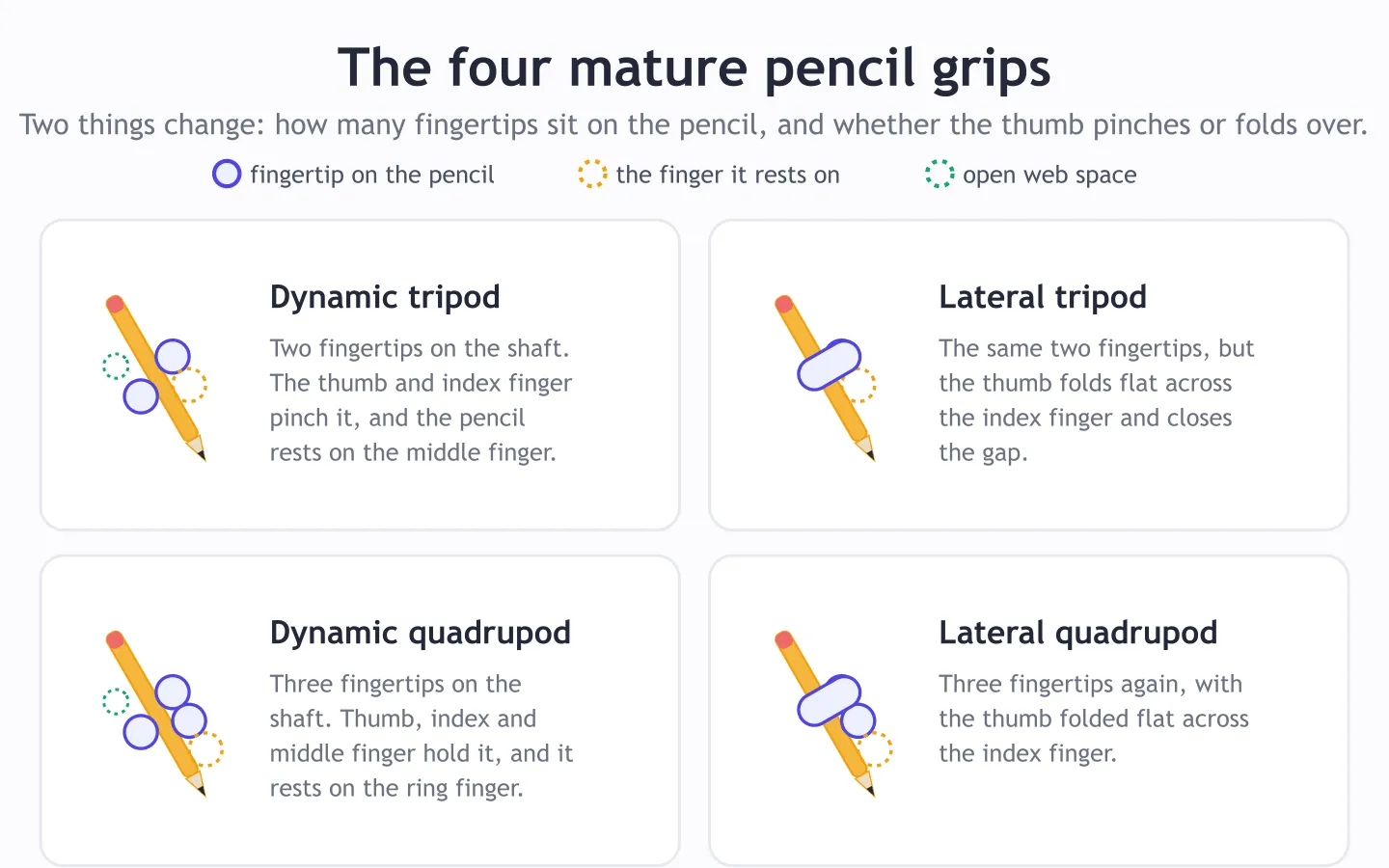
A good pencil hold lets the fingers move the pencil in small motions, so a child can write for a stretch without an aching hand. Most teachers call the target the dynamic tripod: thumb and index finger pinching, middle finger underneath.
Here is the part that rarely makes it onto a worksheet. The tripod is not the only hold that works, and it is not even the most common one. In 2003 two occupational therapists, Susan Koziatek and Nancy Powell, photographed the pencil grip of 101 fourth graders while the kids wrote out the alphabet, then scored their handwriting. Only 38 of them used a dynamic tripod. Another 61 wrote with a lateral tripod, a dynamic quadrupod, or a lateral quadrupod, and none of those groups scored worse.
So the thing to watch is whether the hold works, not whether it matches the poster. Below is how to teach the tripod, which holds are ordinary stages on the way there, which ones are worth changing, and when to stop worrying.
What is the correct way to hold a pencil?
The correct hold is the tripod grip, named for the three fingers that do the work. The thumb and index finger pinch the pencil about an inch up from the tip. It rests on the side of the middle finger. The ring and pinky fingers curl into the palm, which steadies the hand, and the top of the pencil leans back toward the shoulder.
- Pinch the pencil between the pad of the thumb and the side of the index finger.
- Let it rest on the side of the middle finger, about an inch up from the point.
- Curl the ring and pinky fingers gently into the palm.
- Tilt the top of the pencil back toward the shoulder of the writing hand.
Two checks that beat the finger count
Pediatric OTs watch for two things before they count fingers. The first is an open web space: the gap between thumb and index finger should hold a rough circle, not collapse flat. The second is where the movement comes from. Watch the pencil while your child writes a row of letters. If the fingers are flexing and the wrist stays quiet, the grip is doing its job. If the whole hand travels as one block and the elbow or shoulder is pushing the pencil around, that is the thing to work on, whatever the fingers look like.
Kim Griffin, a pediatric occupational therapist, expects that finger-driven control to be in place by about age 7. Before then, a hand that moves as a unit is a stage, not a fault.
Does pencil grip matter for handwriting?
Less than most of us were taught. Two studies compared the four mature grips head to head and found no meaningful gap in speed or legibility. That doesn't make grip irrelevant, but it moves the goal from copying a picture to writing comfortably.
Koziatek and Powell's fourth graders averaged 29.45 letters a minute with a dynamic tripod and 33.54 with a lateral quadrupod. Word legibility averaged 86.48% for the tripod group and 94.09% for the lateral quadrupod, the best of the four. None of those gaps reached statistical significance. In 2012 a Toronto research team led by Heidi Schwellnus tried to break the tie with fatigue: 120 Grade 4 students wrote a 10-minute copy task to tire the hand, and were assessed before and after. Everyone's handwriting got messier and faster. No grip held up better than another.
Three things do carry weight, and they are all easier to spot than a finger position:
- The hand can go for the length of the writing task without pain, cramping, or shaking out.
- The fingers move the pencil. The wrist and forearm rest on the paper instead of dragging it around.
- The child can read back what they wrote a day later.
Pass all three and you can leave the hold alone, whatever it looks like.
What grips do kids use before the tripod grip?
Kids pass through several holds first, and each one is a normal stage. The usual sequence, drawn from OT developmental charts:
- 1 to 2 years: a whole-fist grab with the thumb up. The arm swings from the shoulder.
- 2 to 3 years: all the fingers on the shaft, pointing down at the paper, wrist stiff.
- 3 and a half to 4 years: a static tripod. Three fingers are in the right places, but the hand still moves as one piece.
- 4 to 6 years: the dynamic tripod, where the fingers finally work on their own.
Treat those ages as loose. The reference everyone still cites is a 1990 study by Colleen Schneck and Anne Henderson, who watched 320 children aged 3 to 6 draw and color, 20 boys and 20 girls in every six-month band, and sorted the holds into primitive, transitional, and mature. Even in that careful sample the ages overlap enormously: 48% of the youngest children were already using mature grips, against 90% of the oldest. By four and a half, most kids are somewhere in transitional or mature territory. A tidy staircase is a chart, not a child.
So a 3-year-old holding a crayon in a fist is on schedule. A 6-year-old doing it is worth a look.
Which pencil grips are worth fixing?
Fewer than you'd think. If the writing is legible and the hand doesn't hurt, leave it. These are the holds that earn a change:
- The thumb wrap, where the thumb starts in place and then folds over the index finger and the pencil. It closes the web space and it aches after a few minutes.
- All five fingers spread along the shaft. The pencil gets steered by the arm, so the fine control never develops.
- A full fist past about age 6.
- Constant re-gripping. If your child flips or walks the pencil back up their fingers every couple of lines, the hold isn't stable.
- Any complaint of a sore or tired hand, or a break demanded after two or three lines.
- Knuckles white and the paper dented or torn. That is a pressure problem more than a grip problem, and it has its own fixes.
How do I fix an awkward pencil grip?
Change one thing, then leave it alone for a couple of weeks. Nagging mid-homework rarely sticks, because the child is thinking about spelling, not fingers.
- Break the crayon in half. A one-inch crayon will not fit inside a fist, so the fingers have to pinch it. Golf pencils and chalk nubs do the same job. It's the standard pediatric OT trick because it corrects the hold without a single reminder from you.
- Tuck a cotton ball or a small pom pom under the ring and pinky fingers. Holding it there keeps those two fingers curled and the hand split into a moving half and a steady half.
- Tape the paper to a wall, or use an easel or a chalkboard. Writing on a vertical surface holds the wrist back in the position a tripod grip needs, and it builds shoulder strength at the same time.
- Try a triangular pencil or a slip-on grip, with modest expectations. The research on grip aids is thin and mixed. Treat one as a temporary prompt while the hand learns the position, and drop it if your child hates the feel.
Start with the chair, not the fingers
Some awkward grips are seating problems in disguise. A child whose feet dangle braces with their trunk and arm, and that tension travels straight down into the hand. The setup pediatric OTs aim for is hips, knees, and ankles at roughly right angles, feet flat on the floor, and the desk about two to three inches above the resting elbow. If the feet don't reach, a box or a stack of books under them works. Sort that out before you touch anyone's fingers.
Then give the new hold something easy to do. Tracing is ideal, because the letters are already on the page and the child's attention is free to sit on the grip instead of the spelling. Print a set of letters from the printable handwriting practice sheets, or make a page of their own name with the free name tracing generator, and keep the session to a few minutes.
When should I ask an occupational therapist?
Ask when the grip is costing your child something. Pain, a hand that gives out in three lines, writing they can't read back, or flat refusal to pick up a pencil are all reasons to raise it with the teacher or your pediatrician and ask about an OT screen. A grip that merely looks odd is not.
Timing helps. Pediatric OTs broadly agree that pencil grasp gets hard to shift after about age 7, once the pattern runs on autopilot, so a first grader with a painful thumb wrap is a better moment to act than a fourth grader with the same one. Later is still possible, only slower.
The short version
Aim for the tripod: thumb and index pinching, middle finger underneath, last two fingers curled in. Expect it somewhere between 4 and 7, after a fist stage and an all-fingers stage. Then judge it on comfort, on whether the fingers do the moving, and on whether your child can read the writing back. Those three beat the finger count. If a change is needed, fix the chair first, hand over a broken crayon, and give the new hold five easy minutes a day on a tracing page rather than an hour of corrections on a Sunday.
Make a name tracing worksheet
Type a name, pick a font, and print a free tracing sheet to practise with.