What to do when your child presses too hard when writing
Kids press too hard or too light mostly because of proprioception, the body's sense of how much force its muscles are using. Too hard shows up as dark marks, torn paper, snapped leads, and a sore hand. Too light leaves faint, wobbly lines. Both improve with hand warm-ups, a better pencil, and games like carbon paper tracing that make pressure visible.
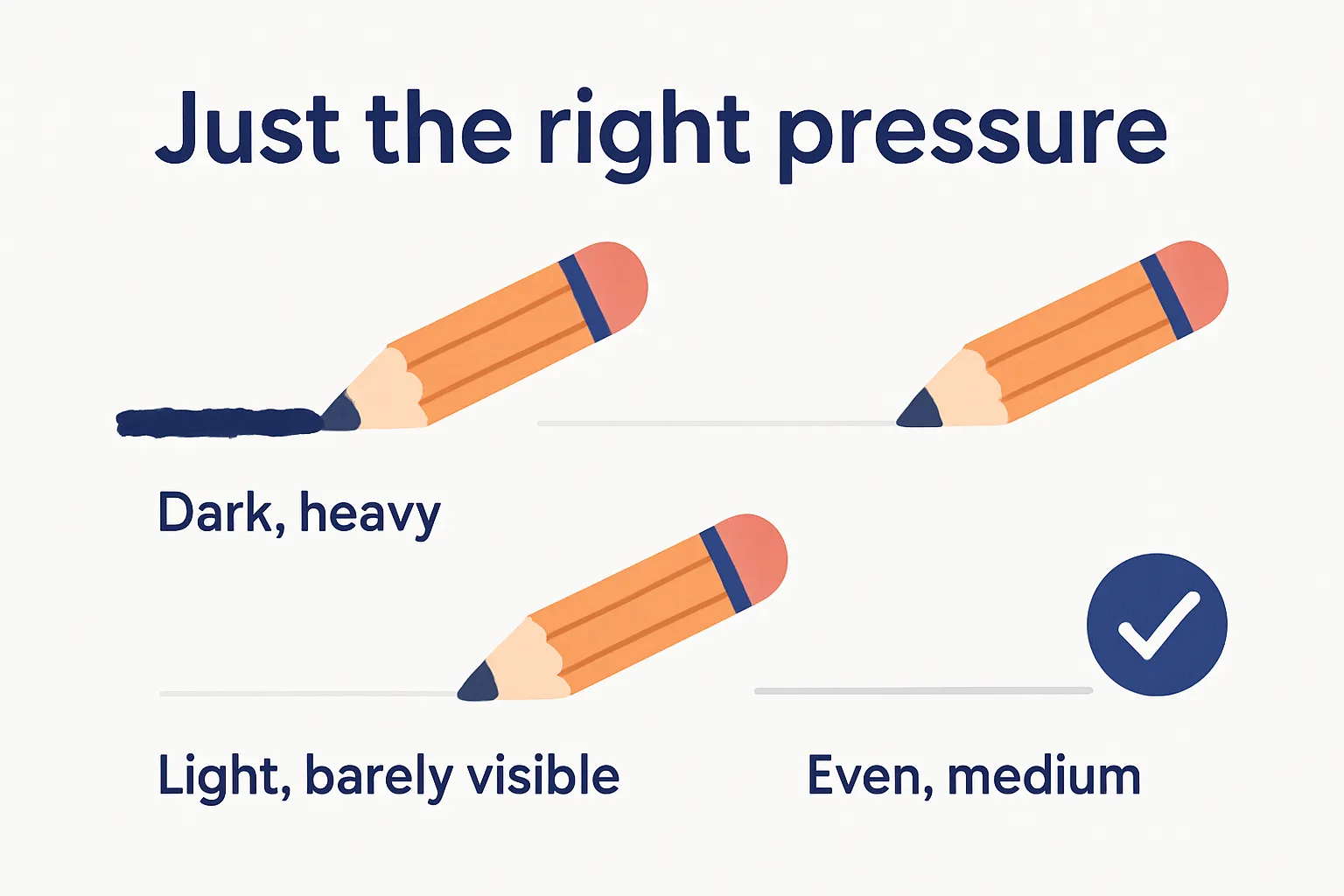
Flip through your child's schoolwork and you can read the pressure like a weather report. Dark, waxy letters you can feel through the back of the page. Holes where the pencil tore through. Eraser marks that dented the paper but never lifted the line. Or the opposite: writing so faint you tilt the page toward the window to find it. Both problems come from the same place, a hand that cannot yet judge its own force.
The good news is that pressure is one of the most fixable handwriting problems, and most of the fixes are games. Ireland's public health service, the HSE, lists the classic signs of pressing too hard: rips in the paper, pencil tips that break a lot, and pain or tiredness in the hand and fingers. Its handwriting guidance recommends the same tools occupational therapists reach for everywhere, including carbon paper games, softer pencil leads, and the mechanical pencil trick, all covered below.
Why does my child press too hard when writing?
Usually because of proprioception, the body's sense of how hard its own muscles are working. Receptors in the muscles and joints constantly report force and position to the brain. When that feedback runs quiet, light pressure is hard to feel, so the child pushes until the pencil finally feels real in their hand.
Two other causes pile on. Weak hand muscles make fine control difficult, so the child locks the fingers, grips like a vise, and drives the pencil from the shoulder, which lands heavy. And plain effort plays a part. A child concentrating hard tenses up, the tension travels down the arm, and the letters come out carved rather than written. Most heavy pressers have some mix of all three.
The grip itself can force the issue too. A fist hold, or a thumb wrapped over the top of the pencil, hands the work to the big arm muscles instead of the fingers, and big muscles do not do gentle. If the hold looks cramped, start there. Our pencil grip guide shows the tripod hold and easy ways to coax a hand into it.
Why do some kids barely mark the page?
Light pressure has the same root, proprioception, showing up the other way. The child cannot feel how little force they are using, so the line comes out ghost pale. Weak hands play a role here too, since a tired hand eases off without noticing. Some kids also hover, keeping the wrist and forearm lifted off the desk, which steals the stability a firm line needs.
Posture feeds into it as well. A child perched on a too-tall chair, feet dangling, spends effort just staying upright, and the writing hand pays for it. Aim for feet flat on the floor, the forearm resting on the desk, and the paper tilted slightly. A stable body lets the hand make small, calm movements, whichever direction the pressure problem runs.
How can I tell if the pressure is wrong?
Check the paper, then check the child. The paper shows the marks. The child shows the effort: a heavy presser complains of a sore or tired hand after a few minutes, while a light presser may drop the pencil, shake the hand out, or keep re-tracing letters that did not show up.
A quick test: run a fingertip across the back of a finished worksheet. If you can read the writing by touch, like braille, the pressure is heavy. And look in the pencil cup. A collection of snapped crayons and stubby, broken-tipped pencils is a pressure report all by itself.
Signs of pressing too hard
- Letters dark enough to read from the back of the page, or embossed into the sheet below.
- Torn paper, snapped leads, and crayons that keep breaking.
- Eraser marks that leave dents and smears, because the line is pressed into the paper, not just drawn on it.
- White fingertips or an overstretched thumb during writing, and a hand that hurts afterward.
Signs of pressing too light
- Faint, wispy lines that are hard to read, or letters that fade partway through a word.
- Wobbly strokes, since a pencil that barely touches the page is hard to steer.
- Frequent re-tracing to darken letters that did not register the first time.
- A loose, floppy grip, or a pencil that slips out of the hand mid-task.
How do I get my child to press more lightly?
Make pressure visible, then make light pressure a game. A child cannot fix a force they cannot perceive, so every good fix turns pressure into something they can see, hear, or feel. Warm up the hand first, then pick one or two of these and run them as play, never as correction.
- The mechanical pencil trick: hand over a cheap mechanical pencil. Press too hard and the thin lead snaps, instantly and every time. The pencil does the nagging so you do not have to, and most kids find the light-touch zone within a few sessions.
- The carbon paper game: slip a sheet of carbon paper and a blank page under the writing paper. The mission is to write so lightly that no copy appears below. Check the bottom sheet together after each line and celebrate clean pages.
- Switch to a soft 2B pencil or a smooth gel pen. Soft leads give a dark line with almost no force, so pressing hard stops paying off.
- Write on a cushioned surface, like a sheet of craft foam or a mouse pad under the page. Heavy pressure dents or tears the paper, and the child feels the difference immediately.
- Do two minutes of heavy work before writing: wall pushes, chair push-ups, squeezing play dough, carrying a stack of books. Loading the muscles wakes up the force sensors, and many kids press lighter right afterward.
What helps a child who writes too lightly?
Run the same ideas in reverse: add resistance, and reward a firmer line. The child needs to feel the pencil meeting the page and to see a strong mark when they push. These work well:
- Flip the carbon paper game. Now the mission is to press firmly enough that the copy does show up on the bottom sheet, on every word.
- Do crayon rubbings. Lay paper over a coin, a leaf, or a textured book cover and rub with the side of a crayon. The picture only appears with steady, firm pressure, so the activity teaches the exact skill.
- Use a soft 2B lead here too, so a readable dark line is within reach, then gradually ask for the same line from a standard pencil.
- Write on paper placed over fine sandpaper, or trace letters in a tray of salt. The drag gives the hand feedback a smooth desk never will.
- The HSE also suggests a light weighted wristband during short practice bouts, which sharpens the arm's sense of position and force. Keep it brief and treat it as an experiment, kept only if it clearly helps.
When does pencil pressure signal something more?
On its own, almost never. Odd pressure is one of the most common handwriting complaints in the early grades, and most kids find the middle ground with practice and the games above. Look closer when pressure trouble travels with other signs, because then the pressure is a symptom rather than the whole story.
- The child avoids drawing, cutting, and building too, so the struggle covers all hand tasks, with writing simply the loudest.
- Fatigue shows up everywhere: slumping at the desk, propping the head on a hand, tiring fast in play.
- Pain that keeps coming back, or a grip that still looks effortful and cramped past age 7 despite good habits.
- Weeks of relaxed, regular practice with feedback games produce no change at all.
If several of those ring true, ask the school about an occupational therapy screening, or mention it to your pediatrician. OTs treat pressure problems all the time, and an evaluation is information, never a verdict. Meanwhile, keep sessions short and cheerful. A tense child presses harder, so the mood in the room is part of the treatment.
For practice material, tracing is ideal, because the shapes are already decided and all of the child's attention can go to touch. Print a page from the printable handwriting practice sheets and run the carbon paper game on it, or make a worksheet from your child's own name with the free name tracing generator. A few minutes, twice a day, beats one long Saturday drill.
Make a name tracing worksheet
Type a name, pick a font, and print a free tracing sheet to practise with.