Free Printable Cursive Worksheets
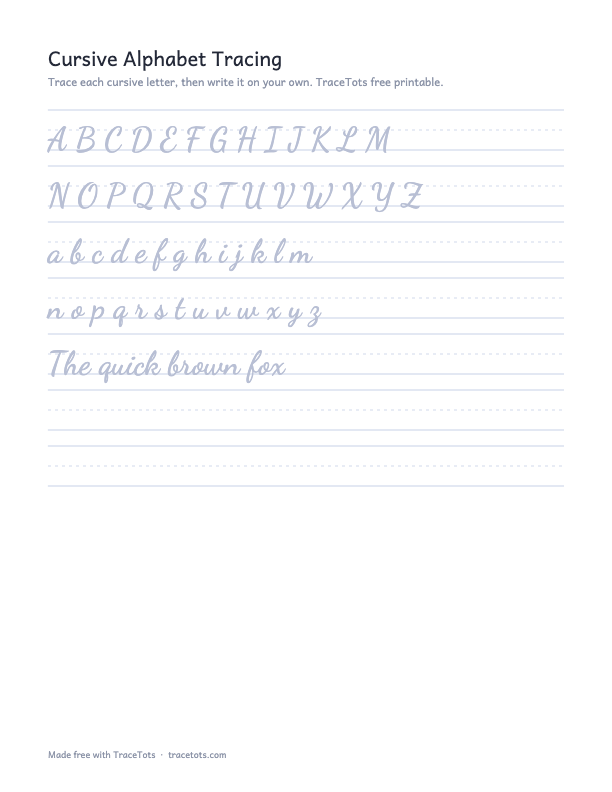
These free cursive worksheets print as one PDF with the full cursive alphabet, both uppercase and lowercase, on guided rows. Trace each joined letter, and the blank rows let you write it from memory.
US Letter · prints on any standard printer · no signup
What this worksheet is
This printable PDF holds the full cursive alphabet, uppercase A to Z and lowercase a to z, plus a sample sentence, all on classic three-line rule. The letters print as light outlines. Learners trace the joined strokes first, then write each letter unaided in the blank rows.
Cursive builds the smooth, connected hand movements that print writing does not. Tracing the outlines drills the entry and exit strokes. That is the part learners tend to get wrong when they first join letters.
This sheet suits children in second and third grade, roughly ages 7 to 9, which is when schools that teach cursive usually introduce it. It also fits older kids who never got cursive at school and adults who want to relearn a joined hand. If a child is still forming print letters unevenly, give print a little more time first. Cursive goes better once the basic shapes are steady.
Teachers often set this page out at a writing station: each child traces one row, writes one row solo in the blank space, and rotates on, so a single laminated copy can serve a whole small group. At home, sit beside your child for the first few letters, watch where each stroke begins, then step back. Five to ten minutes at a stretch is plenty. Attention fades fast after that, and rushed repetitions teach rushed habits.
The three-line rule earns its keep in cursive. Joined writing depends on every lowercase letter sharing the same x-height, and the dashed midline keeps that visible while the child writes, so the connections land at a consistent height. If a child struggles with this sheet, shrink the task. Practise letters that share an entry stroke as a group, like i, u, w, and t, before mixing the whole alphabet, and trace one letter three times slowly rather than a full row fast.
How to use it
- Print the PDF on US Letter paper.
- Trace each cursive letter slowly, in the direction the stroke wants to go.
- Work on the joining strokes. Cursive is about how letters connect, not the shapes on their own.
- Use the blank rows to write each letter from memory.
- Want a page with your child's name on it? Make a cursive version in the generator.
Quick tips
- Keep the slant steady. If it helps, rest the paper at a slight angle.
- Work on lowercase letters first. They show up far more often than capitals.
- Teach letters in stroke families instead of alphabetical order. The undercurve group (i, t, u, w) shares one entry motion, so early wins come faster.
- Have the child trace a letter with a finger before picking up the pencil. One dry run tells the hand where the stroke turns, with no pressure to mark the page.
- Slip the sheet into a plastic page protector and trace with a dry-erase marker. One printout then covers weeks of practice.
Want a worksheet with your child's name?
Make a free custom name-tracing worksheet in print or cursive.
Frequently asked questions
Is this cursive worksheet free to print?
Yes. The full cursive alphabet PDF is free to download and print, with no signup.
Does it include both uppercase and lowercase cursive?
Yes. The worksheet covers cursive letters in uppercase A to Z and lowercase a to z, plus a practice sentence.
Can I get a cursive worksheet for my name?
Yes. Open the Name Tracing Generator, switch the style to Cursive, and you get a custom name worksheet.
What age is cursive handwriting taught?
Schools usually introduce cursive around ages 7 to 9. It suits any learner, adults included, who wants a flowing joined hand.
Should my child learn cursive with a pen or a pencil?
Start with a regular pencil. It gives better friction and control, and mistakes erase cleanly. Switch to pen once the letter shapes and joins feel steady.
How many times should a child trace each cursive letter?
Three to five slow, careful traces per sitting beat a whole row done quickly. Stop while the strokes are still accurate, because tired tracing drills the wrong pattern.
Can I print this cursive worksheet on A4 paper?
Yes. The PDF is laid out for US Letter, so on A4 choose "Fit to page" or "Scale to fit" in your print dialog and it prints cleanly with all rows intact.
More free printables
Calligraphy
Free printable calligraphy practice sheets (PDF). Script letters on slanted guide rows for slant and stroke control. Print at home, no signup.
Open & downloadHandwriting Practice
Free printable handwriting practice sheets (PDF). Trace the print alphabet, A to Z, on guided rows. Write it solo below. Print it free, no signup.
Open & downloadLined Paper
Free printable lined paper for handwriting (PDF). Three-line rule with a dashed midline that guides letter height. Print as many pages as you need.
Open & download