Printable Handwriting Practice Sheets
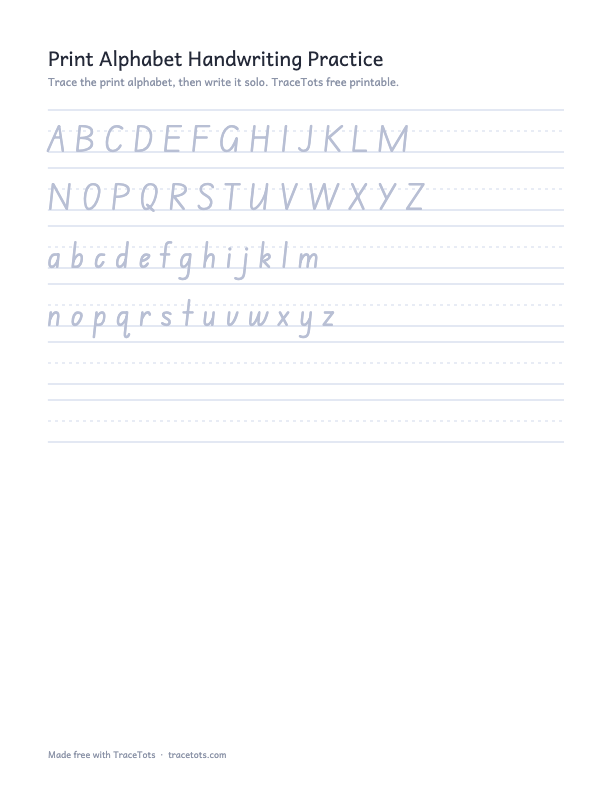
These free handwriting sheets print as a PDF of the print alphabet, uppercase and lowercase, on guided rows. Trace each outlined letter, and a blank space on the same line lets you write it solo.
US Letter · prints on any standard printer · no signup
What this worksheet is
This free printable PDF holds the print (manuscript) alphabet, uppercase A to Z and lowercase a to z, as light outline letters on three-line rule. Learners trace each letter to learn its shape and stroke order, then write it on their own in the blank rows below.
Print handwriting is the first thing most children learn. The outline-then-write layout builds correct letter formation and even height, which makes the later jump to joined or cursive writing much easier.
This sheet fits children from about age 4 through second grade, the window when print letter formation is the main handwriting job. A younger child who can already draw circles, crosses, and straight lines is usually ready to try tracing letters. If a preschooler is not there yet, chunky crayon drawing and simple mazes build the same pencil control without any pressure.
Kindergarten and first-grade teachers often slot this page into a literacy station rotation: trace one letter family, write one row solo, then move to the next activity. The uppercase and lowercase pairs also make it a natural letter-matching task. At home, tie the letters to real life. After tracing the letter m, go hunt for an m on a menu, a cereal box, or a road sign. Letters with meaning stick faster than letters on their own.
The hollow outlines let a child self-correct mid-stroke, because their pencil line stays visible inside the letter shape, and the empty rows underneath show you exactly which letters need another pass. If one letter keeps going wrong, isolate it and practise its whole stroke family, since c, o, a, d, and g all begin with the same curve. Once single letters are solid, a custom sheet from the Name Tracing Generator is a motivating next step: a child's own name is the word they most want to write.
How to use it
- Print the PDF on US Letter paper.
- Trace each letter in the correct stroke order.
- Keep lowercase letters between the baseline and the dashed midline.
- Write each letter solo on the blank practice rows.
- Want a sheet with your child's name on it? Generate one in the name tool.
Quick tips
- Start with lowercase. It makes up most of everyday writing.
- Short, frequent sessions beat the odd long one for letter formation.
- Teach letters in formation families: c, o, a, d, and g share a starting curve, while l, t, and i share a straight down-stroke. Grouped practice sticks faster than A-to-Z order.
- Watch the first stroke, not the finished letter. Most formation problems, including b and d confusion, begin at the wrong entry point.
- Try a short golf pencil instead of a jumbo one. Short pencils leave no room for extra fingers, so they nudge small hands toward a proper tripod grip.
Want a worksheet with your child's name?
Make a free custom name-tracing worksheet in print or cursive.
Frequently asked questions
Are these handwriting practice sheets free?
Yes. The print alphabet PDF is free to download and print, with no signup.
Does it include uppercase and lowercase?
Yes. The worksheet covers print letters in both uppercase A to Z and lowercase a to z, on guided rows.
What age is this for?
It fits pre-K through early elementary kids who are building print letter formation.
Can I make one with my child's name?
Yes. The Name Tracing Generator builds a custom name worksheet in the same trace-then-write format.
Should my child trace with a pencil or a marker?
A regular pencil suits most kids, since it gives friction feedback and erases. For a 3 or 4 year old still building hand strength, a fine-tip marker needs less pressure and can be a friendlier start.
How many repetitions of each letter are enough?
Three to five careful traces per letter per sitting is plenty. Stop before quality drops, because tired, sloppy repetitions train the wrong pattern.
My child confuses b and d. Will tracing help?
Yes. The two letters start differently (b begins with the tall line, d begins with the curve), and tracing drills that difference into muscle memory. Mixing up b and d is common through about age 7.
More free printables
Lined Paper
Free printable lined paper for handwriting (PDF). Three-line rule with a dashed midline that guides letter height. Print as many pages as you need.
Open & downloadNumber Tracing
Free printable number tracing worksheets (0 to 9) as a PDF. Big outlined numerals on guided rows help kids learn to write each number. No signup.
Open & downloadCursive Worksheets
Free printable cursive worksheets as a PDF. Trace the cursive alphabet, uppercase and lowercase, on guided rows. Write it solo below. No signup.
Open & download