Calligraphy Practice Sheets
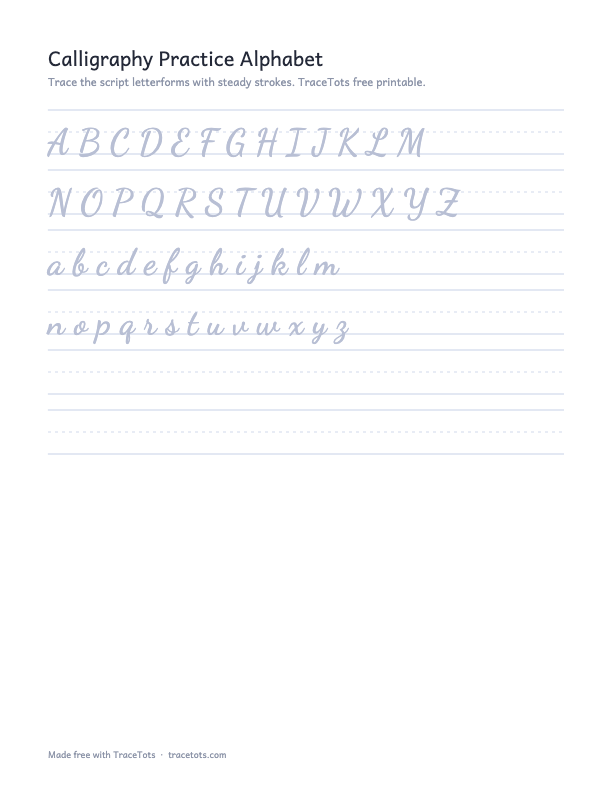
These free calligraphy practice sheets print as a PDF: a script alphabet on slanted guide rows. Trace the letterforms to steady your strokes and build a flowing hand.
US Letter · prints on any standard printer · no signup
What this worksheet is
These free calligraphy practice sheets lay out a script alphabet, uppercase and lowercase, as light outlines on guide rows. Trace the letterforms to steady your stroke shape and weight, which is the base of a clean calligraphy hand.
Calligraphy is about slow, controlled strokes, not everyday speed. Tracing the outline trains your hand to follow the curve and rhythm of each letter, before you take on thick-and-thin contrast with a real pen.
These sheets suit teens and adults picking up calligraphy for the first time, and anyone returning after a long break. No experience is needed: if you can trace slowly and keep your grip relaxed, you can start today. Kids can enjoy them too, though most find script letterforms easier from about age 10, once their everyday handwriting is comfortable.
The hollow outlines are deliberate. When you trace inside an outline instead of over a solid grey letter, you can see your own line the whole time, so any drift shows up the moment it happens. The guide rows keep your x-height and slant consistent, and that consistency is most of what separates tidy lettering from wobbly lettering. Art teachers use pages like this as a quiet early-finisher station; at home, ten to fifteen minutes with music on is a realistic session.
If your letters look shaky, the fix is usually speed, pressure, or grip. Drop to about half your normal writing pace, lighten your hold on the pen, and let your forearm rest on the table so the motion comes from the arm. When you want to letter something personal, the Name Tracing Generator can put any name or short word on a traceable sheet, which is a nice bridge between alphabet drills and a finished card or gift tag.
How to use it
- Print the PDF on smooth US Letter paper for the cleanest lines.
- Trace each letter slowly. With calligraphy, control beats speed.
- Keep the slant even and the spacing between letters steady.
- Once you feel ready, write the letters freehand on the blank rows.
- Move up to a brush pen or broad-nib pen to add stroke contrast.
Quick tips
- Warm up with a few rows of ovals and slanted lines before you start letters.
- Keep your wrist loose and move from the whole arm, not the fingers.
- Rotate the page instead of twisting your wrist. Find the paper angle where the slant feels natural and keep it the same every session.
- Date each finished sheet and keep it. Comparing week one to week four shows progress your eye misses from day to day.
- Print a fresh copy rather than re-tracing an already inked sheet. Old lines pull your eye, and your pen, off course.
Want a worksheet with your child's name?
Make a free custom name-tracing worksheet in print or cursive.
Frequently asked questions
Are these calligraphy practice sheets free?
Yes. The calligraphy alphabet PDF is free to download and print with no signup.
Do I need special pens?
No. You can start by tracing with any pen or pencil. A brush pen or broad-nib pen helps later when adding stroke contrast.
Are these good for beginners?
Yes. Tracing outlined letterforms is one of the easiest ways to learn calligraphy basics before you try freehand work.
What script style is used?
The sheets use a flowing script alphabet that works for modern calligraphy and for lettering practice.
How long does it take to learn basic calligraphy?
Most beginners see visible improvement after two to three weeks of short daily tracing. A settled, confident hand usually takes a few months of regular practice.
Should I practise calligraphy every day?
Short and regular wins. Ten to fifteen minutes a day builds control faster than one long weekend session, and your hand stays fresh the whole time.
What paper should I print these sheets on?
Standard printer paper is fine for pencil work. If you move on to brush pens, a smoother, heavier sheet such as 32 lb laser paper is kinder to the delicate tips.
Is calligraphy the same as cursive?
No. Cursive is everyday joined handwriting written at normal speed. Calligraphy is decorative lettering drawn slowly, stroke by stroke, often with deliberate thick and thin lines. Practising one still helps the other, since both reward a steady slant and even spacing.
More free printables
Cursive Worksheets
Free printable cursive worksheets as a PDF. Trace the cursive alphabet, uppercase and lowercase, on guided rows. Write it solo below. No signup.
Open & downloadAdult Practice
Free printable handwriting practice for adults (PDF). Clean rows and full-sentence pangrams, no childish themes, to help you fix messy handwriting.
Open & downloadLined Paper
Free printable lined paper for handwriting (PDF). Three-line rule with a dashed midline that guides letter height. Print as many pages as you need.
Open & download