Child not spacing words when writing: how to help
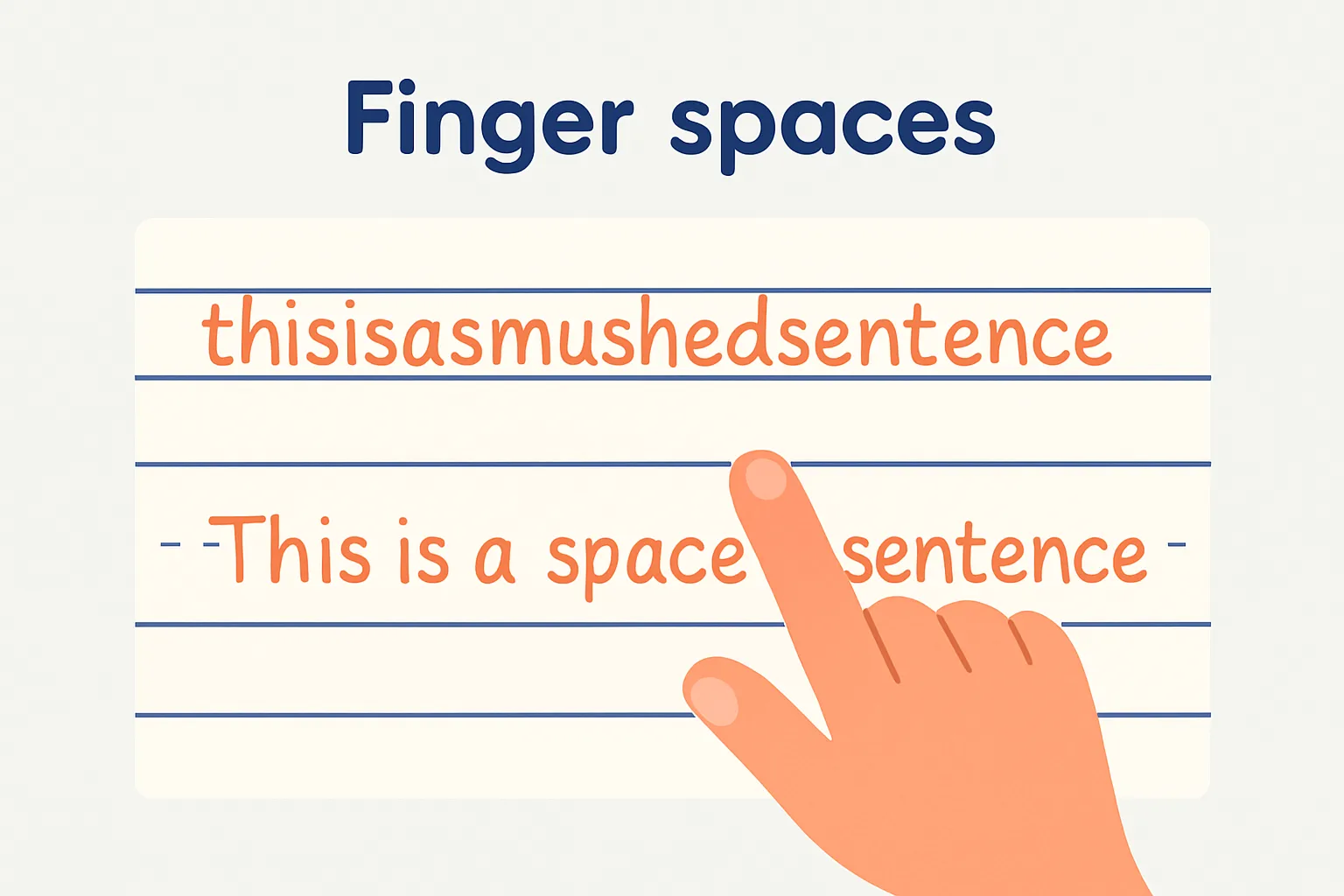
Beginning writers squash words together because forming letters still takes all their attention, and a space is easy to forget when the mind is full. Most kids space words reliably by age 6 or 7. Until then, concrete tools work best: a finger laid down between words, a decorated spacer stick, or paper with a box for each word.
mydogisbig. If your child's sentences come out as one long train of letters, welcome to one of the most common stops in early writing. The words are all there, often spelled bravely. The spaces are missing, because a space is the one part of a sentence you cannot see. This guide covers why it happens, what is normal at each age, and the concrete tools that fix it faster than any amount of reminding.
It is worth fixing early, because spacing pays back out of proportion to the effort. The occupational therapists at The OT Toolbox point out that white space between words makes even sloppy or poorly formed letters easier to read. In other words, a child whose letters are still rough gets an instant legibility boost just from leaving gaps. Few handwriting fixes give back that much, that fast.
Why does my child squash words together?
Because forming letters still takes all their attention. A beginning writer spends their whole working memory deciding which letter comes next and how to build it. A space is an absence you must remember to leave, and it is the first thing to drop when the mind is full. Once letters become automatic, attention frees up and spaces start appearing.
There is a deeper reason too. Spoken language has no gaps. We do not pause between words when we talk, so a child who writes "mydogisbig" is faithfully recording exactly what they hear. The idea that print slices speech into separate words is a real discovery, part of learning to read, and some kids have not fully made it yet when they start writing sentences.
You can watch this in real time. Ask a young writer to say their sentence out loud, and it comes out in one smooth stream. Then ask them to count the words in it, and many kindergartners genuinely cannot yet. Hearing a sentence as separate words is a skill of its own, and it comes before spacing, because a child cannot separate words on paper that they cannot separate in their head.
Finally, spacing is a spatial judgment. The OT Toolbox ties spacing trouble to visual motor integration, the skill of matching what the eyes judge with what the hand does. Deciding where the next word should start, and landing the pencil there, is a different skill from forming an a or a t. Different skill, different practice.
When should kids space words on their own?
Expect reliable spacing around age 6 to 7, usually during first grade. In kindergarten, run-together words and random gaps are completely on schedule. What you want to see is a direction of travel: across first grade, spaces appear more often, then most of the time, then consistently.
Experience matters more than the birthday here. A child who started writing sentences early may space early, and a child who only began stringing words together in first grade will get there later, on the same internal timeline. Count from when sentence writing started, and give it several months of regular writing either way.
Before age 6, treat missing spaces as information, never as a fault. The child is telling you their letters are still expensive. If a child past 7 or 8 still runs words together often, and the writing has other struggles alongside, like unreadable letters or real distress about writing, mention it to the teacher. On its own, late spacing is usually just late.
What tools teach spacing between words?
Concrete ones. Young children are concrete thinkers, so an invisible gap needs a stand-in they can see and touch. Every trick below turns the space into a thing. Start with the finger, move to a stick if you need to, and keep the whole business playful.
- Finger spacing: after each word, the child lays the index finger of their non-writing hand on the paper and starts the next word on the far side of it. Free, always available, and the classic first tool.
- A spacer stick: a craft stick with a little face drawn on top, often called a spaceman. The child parks it on the line after each word. Let them decorate their own, because kids actually use the tools they helped make.
- Highlighting spaces: after writing, hand over a highlighter and have the child mark every gap, then count them together. Sentences with more colored bars win.
- Dot spacing: while writing, the child places a small pencil dot or a sticker after each word, then starts the next word past it. Fade the dots once the habit holds.
- Boxes and graph paper: one word per box with an empty box between, or large-squared graph paper where each space gets its own blank column.
Whichever tool you pick, praise the spaces out loud and specifically. "I can read every word because you left such clear spaces" teaches more than "good job." Beginning writers rarely hear that the gaps count as an achievement, so naming them as one changes what your child watches for on the next line.
Pick one tool and stay with it for a couple of weeks before judging. Switching tools every few days resets the habit, and the habit is the point. Most families land on the finger or the stick, use it for every writing task, and watch the spaces show up on their own within a month or so.
One caution for left-handed kids: finger spacing is awkward for them, because the spacing hand and the writing hand end up crossing. A lefty does better with the spacer stick or the dot method from the start. Our left-handed handwriting guide covers the rest of their setup.
Does lined or three-line paper help with spacing?
Yes. Lined paper takes over part of the spatial work, and three-line paper, with its dashed midline, settles letter height so the child can spend attention on the gaps between words instead. The fewer judgments a young writer has to juggle at once, the more spaces survive onto the page.
Start big and shrink slowly. Wide three-line paper with letters an inch tall leaves room for real, visible spaces. As control grows, move to narrower lines. Some classrooms use paper with a highlighted bottom half or a darkened baseline, and both help the same way, by making the invisible structure of the line visible.
Worksheets with a traced model do quiet work here too. When a child traces a sentence printed with proper gaps, the hand travels the spaces as well as the letters, and the rhythm of word, gap, word starts to sink in. Type a short sentence into the free name tracing generator, print it, and let your child trace the line, then copy it underneath with a spacer stick on duty.
How do we practice spacing step by step?
Little steps, in this order, a few minutes at a time. The sequence runs from noticing spaces to using them without any help:
- Show why spaces matter. Write "ilikemydog" and ask your child to read it, then write it again with spaces. Laugh about the squashed version. The point lands better as a joke than as a lesson.
- Read with a finger. During storytime, have your child point to each word as you read it, so they see that print comes in separate chunks with gaps between them.
- Copy with a tool. Write a short sentence as a model, and have your child copy it using finger spacing or the spacer stick after every word.
- Highlight and count. After each writing task, the child highlights the spaces and counts them. That turns progress into something you can measure in colored bars.
- Fade the tool. Swap the stick for the finger, then for an imaginary spaceman the child just pictures. Then try a dictated sentence with no model and no tool at all.
Expect the tool phase to last weeks, not days, and expect relapses whenever the writing gets hard. A child who spaces perfectly while copying may squash everything the first time they write about their own birthday, because the excitement eats the attention again. That is not backsliding. It is the same rule as always: whatever fills the mind wins.
Keep sessions to two or three sentences. Spacing practice rides along on any writing your child already does, a card for grandma, a label for a drawing, one item on the shopping list. Short, real, and slightly silly beats a worksheet marathon, though a traced page from the printable handwriting practice sheets makes a calm warm-up before the free writing starts.
Make a name tracing worksheet
Type a name, pick a font, and print a free tracing sheet to practise with.