Teaching lowercase letters: when and how to make the switch
Most children are ready for lowercase letters around age 5 or 6, once they can write most capitals from memory. Capitals come first because their straight lines and simple curves suit small hands. Teach lowercase in families, tall letters, small letters, and tail letters, and keep the reversible pairs like b and d weeks apart so they never blur together.
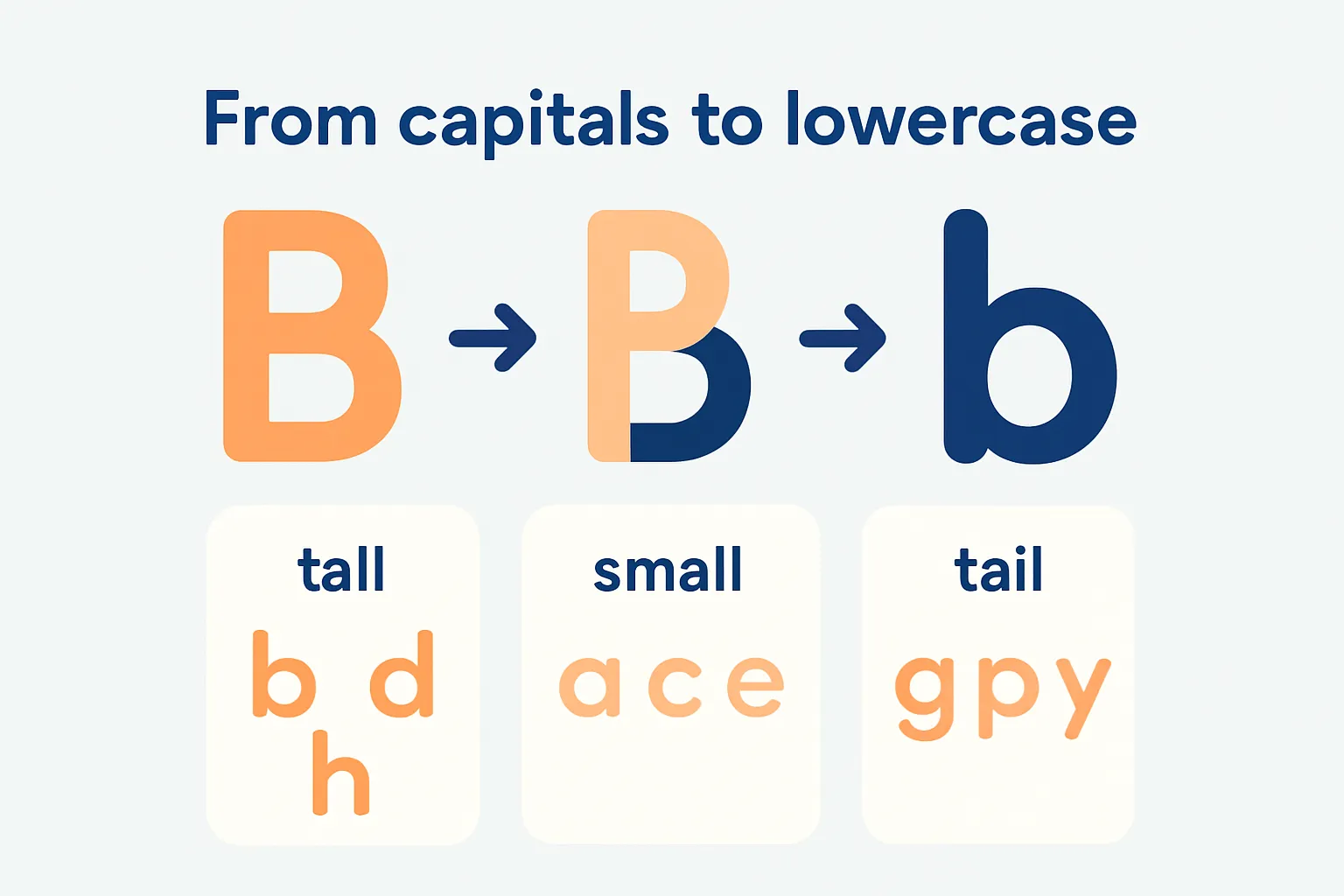
Somewhere between preschool and first grade, every child trades the big block capitals for the smaller, curvier lowercase alphabet. It is a real shift, and worth doing on purpose. Almost everything your child will ever read is printed mostly in lowercase, so the sooner those shapes feel familiar, the easier reading and writing both get. This guide covers when to switch, how to group the letters, and what to do about the pairs that flip.
First, the capitals-then-lowercase order is sound. In a preschool writing study published in the NIH library, children wrote about 11 percent of capital letters correctly at age 3, 40 percent at age 4, and 74 percent at age 5. The same researchers note that children learn to write uppercase letters before they learn lowercase. So capitals first is the normal path, and the question is when to take the next step.
Why do children learn capital letters first?
Because capitals are simpler for the hand. Most are built from straight lines and single curves, they all stand the same height between two lines, and none of them hang below the baseline. Lowercase letters add loops, tails, retraced strokes, and four letters that change identity when they flip. A small hand manages the simple strokes first.
Look at the difference up close. A capital E is four straight lines with corners to rest at. A lowercase e is one continuous curve that starts in the middle, loops up, and swings around, with no corner anywhere. A capital B is a line and two bumps. A lowercase b is a line plus a circle that has to land on the correct side, or it turns into a d. Lowercase asks for more control and more precision at the same time.
None of this makes all-caps writing a bad habit to panic over. Children who write in capitals for a long stretch are using the tools they have, and they are not behind. The goal is simply to add lowercase to the toolbox before all-caps hardens, because in first and second grade teachers start asking for the standard mix, and reading fluency leans on knowing the small shapes cold.
When should a child move from capitals to lowercase?
Around age 5 or 6, once most capitals come out without help and without hard thinking. For many kids that lands in late preschool or kindergarten, which is also when schools begin teaching both forms side by side. You are not waiting for perfect capitals. Recognizable and fairly automatic is enough.
Two green lights matter more than the birthday. First, the capitals are automatic, meaning your child can write most of them from memory while thinking about something else, like what the word says. Second, the hand can manage small curves, which shows up in drawing: circles that close where they started, wavy lines that stay on a path. If both are there, start lowercase even if a few capitals still wobble.
The natural first project is your child's own name in its everyday form, one capital at the start and lowercase for the rest. That is how the name appears on cubbies, library cards, and birthday cards, so the motivation is built in. Our guide on teaching a child to write their name walks through that routine step by step.
What if my child resists lowercase?
Shrink the ask. One new letter, traced big, for a few minutes. Pick letters from their name first, since those pay off immediately, and let all-caps stand everywhere else for now. Kids write with whatever feels easiest, so the job is to make lowercase the easy option, not to ban capitals. Once the new letters get fluent, they start showing up on their own.
What are the tall, small, and tail letter families?
Lowercase letters sort into three families by height, and teaching them by family gives your child one rule at a time. Tall letters reach the top line. Small letters live in the middle space. Tail letters drop below the baseline. Here is the full roster:
- Tall letters: b, d, f, h, k, l, and t. They start at or near the top line, the way capitals do.
- Small letters: a, c, e, i, m, n, o, r, s, u, v, w, x, and z. They fit in the middle space, from the midline down to the baseline.
- Tail letters: g, j, p, q, and y. Their tails hang below the baseline, into the space underneath.
Kids remember the families faster with a picture. Draw a simple house over the writing lines: the middle space is the main floor, the top space is the attic, and below the baseline is the basement. Tall letters poke into the attic, small letters stay on the main floor, and tail letters dip into the basement. Some teachers use sky, grass, and roots instead. Either one gives the child a concrete answer to the question every beginner asks: where does this letter go?
Three-line paper, the kind with a dashed midline, makes the families visible on the page. Small letters fill the bottom half, tall letters reach the top line, tails drop below. If your child writes every lowercase letter the same size, the paper is the fix, not a lecture.
Size is the other adjustment. Lowercase letters are smaller than the capitals your child has been writing, and smaller means finer control. Start big anyway: fat crayon letters on wide three-line paper, shrinking over weeks as control grows. Big and correct beats small and scribbled every time.
Which lowercase letters are the trickiest?
The reversible ones: b, d, p, and q. All four are a stick and a circle, and only the arrangement changes, so young writers flip them constantly. Mixing them up is normal until around age 7 or 8. The fix is spacing the pairs out in time and anchoring each letter to its starting stroke.
- Teach b and d in different weeks, never in the same session, so the two shapes cannot blur together.
- Anchor d to c: a d starts as a c, then adds the stick. A b starts with the stick, then adds the belly. Different starts, different letters.
- Keep p and q apart the same way. Most kids meet q last anyway, since so few words use it.
- Watch the retraced letters too: h, m, n, and r all need the pencil to travel back down a line it just drew, and extra humps sneak in when kids rush.
The letter s deserves a mention as well. It changes direction twice inside one small stroke, and a backwards s survives longer than most reversals. Slow it down: start with a tiny c at the top, then swing back the other way. Saying the path out loud while tracing helps more than writing it wrong ten more times.
If b and d keep swapping after the other letters settle, that is common and fixable. Our b and d reversal guide has the memory tricks teachers rely on, including the one where two fists spell the word bed.
What order should we teach lowercase letters in?
Start with the letters that are just small versions of their capitals, because your child already owns those shapes. Then move through the rest in groups that share a starting stroke. A sequence that works:
- Same-shape letters: c, o, s, v, w, x, and z. Only the size changes, so these come almost free.
- Your child's name in its normal form, one capital and the rest lowercase.
- Round letters that begin with a c stroke: a, d, g, and q. Make the c, then add the stick or the tail.
- Stick-first letters: l, t, i, h, n, m, r, b, and p. Draw the line down, then add the rest.
- The stragglers with quirks of their own: e, f, j, k, u, and y.
Notice that this order splits the troublemakers automatically. The letter d sits in the c-stroke group and b sits in the stick-first group, so they are learned weeks apart, and p and q land in different groups too. Two or three new letters a week is plenty. A letter should feel easy before the next one arrives.
Tracing carries most of the load here, because the child follows a correct model instead of inventing the shape from a blank page. Print the lowercase rows from the printable handwriting practice sheets, or type your child's name or a favorite word into the free name tracing generator and let them trace the everyday mixed-case form until it feels like theirs.
Make a name tracing worksheet
Type a name, pick a font, and print a free tracing sheet to practise with.