Letter reversals: why kids flip b and d, and how to help
Reversing letters is a normal stage, and most kids are writing them the right way round by the end of third grade, around age 7 or 8. Children flip left-facing letters like d, q and J far more often than right-facing ones like b, p and c. Teaching the starting point and stroke of one letter at a time fixes it faster than any memory trick.
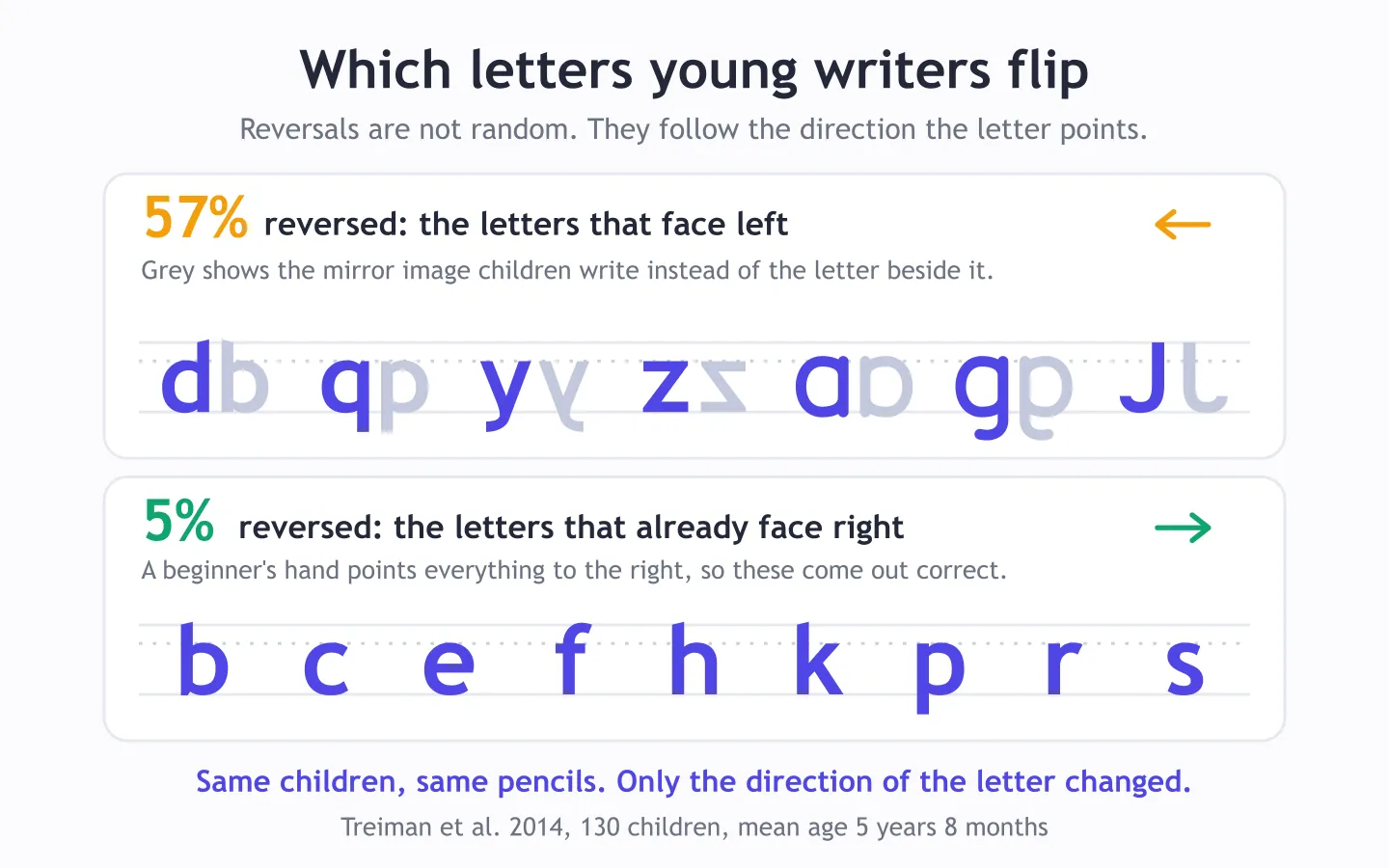
If your child writes "dad" as "bab", that is ordinary five-year-old handwriting. In 2014 a team led by Rebecca Treiman at Washington University in St. Louis had 130 children, average age 5 years 8 months, write letters to dictation. The results came out lopsided. Letters that face left, like d, q and J, were written backwards about 57% of the time. Letters that face right, like b, p and c, were written backwards about 5%. Same children, same pencils, roughly ten times the error rate depending on which way the letter points.
That changes the advice. Most kids who flip a d know exactly what a d looks like. What they have not learned yet is that direction carries meaning for letters, in a way it never does for anything else in the world. So the hand guesses, and it guesses right-facing.
Why do kids reverse letters like b and d?
Because a child's visual system was built to ignore direction. A cup is a cup facing left or right. A dog is a dog either way. Reading is the one place that rule breaks, so learning letters means unlearning a piece of vision that has worked perfectly since birth.
Researchers call the thing being unlearned mirror invariance. Stanislas Dehaene's group at the French research institute INSERM has scanned readers to watch it come apart. In the patch of the left fusiform cortex that handles written words, a flipped picture still registers as the same picture, while a flipped letter or word stops doing so once a person learns to read. Adults who never learned to read keep treating mirrored shapes as identical. Readers stop. Lowercase b and d are the last holdouts, because the two use the same stick and the same circle, with nothing changed but the side.
So a reversal is a stage in that rewiring rather than a vision problem or a sign of carelessness. The rewiring takes a couple of years of reading and writing to finish.
Which letters do kids reverse the most?
The left-facing ones, by a wide margin. In the Treiman study, d, q, y, z, a, g and J were reversed roughly 57% of the time. The letters b, c, e, f, h, k, p, r and s were reversed about 5%. Of the 130 children, 86 showed that lopsided pattern and only 8 showed the opposite one.
- Flipped often: d, q, y, z, a, g and J. Every one of them faces left, and a beginner's hand wants to face right.
- Flipped rarely: b, c, e, f, h, k, p, r and s. These already point the way the hand expects.
- Numbers do it too. Jean-Paul Fischer, a French researcher who has spent years on mirror writing in kindergartens, found the digit 3 written backwards in about 46% of attempts and the digit 4 in about 16%.
- Capitals follow the same rule. J, Z, N and S give young writers more trouble than B or E.
Carry that first point to the homework table. When "dad" comes out as "bab", the b was never the problem. Something went wrong at the d, and the d is what to practice.
When are letter reversals normal, and when should I worry?
Reversals are expected through kindergarten and first grade, and mostly gone by the end of second. Understood, the US nonprofit for learning and thinking differences, puts the ordinary end point at around age 7. Frequent reversals that are still there at the end of third grade are the point to raise it with the teacher.
- Ages 4 to 6: expected. Nearly every child does it. Keep practice short and keep it light.
- Ages 6 to 7, grades 1 to 2: tapering off. A flipped d on a tired Friday afternoon means nothing.
- End of grade 3, about age 8: most children have stopped. Frequent reversals now are worth a conversation.
- Any age, alongside reading trouble: mention both together rather than the reversals alone.
Two things matter more than the calendar. The first is whether the flips are occasional or constant. The second is whether writing is getting easier month by month. A child who reverses a d twice on a page of twenty words is on a different track from one who reverses it every time and cannot read their own sentence back.
Do letter reversals mean dyslexia?
No, not on their own. This is the most stubborn myth in early literacy. Treiman's team followed those same 130 children for 2 years and 8 months, to a mean age of 8 years 4 months, then checked whether the early reversals predicted later reading scores. They did not.
The two groups came out almost identical. Children who later scored 90 or below on the literacy measures had reversed left-facing letters about 59% of the time as five year olds. Children who scored above that had reversed them about 55%. The researchers concluded that reversal errors are a poor predictor of future reading problems.
The International Dyslexia Association says the same thing in plainer words: most children who reverse letters before age 7 turn out not to have dyslexia, and there is no evidence that dyslexic readers see letters backwards. Dyslexia is a difficulty with the sounds inside words. If reversals are still frequent past third grade next to slow reading, weak rhyming, or trouble sounding out unfamiliar words, ask the teacher about a screening. Ask because of the cluster, not because of the d.
How do I help my child stop reversing b and d?
Teach the movement, not the picture. A child who knows where the pencil starts and which way it travels has a motor plan to fall back on, and a motor plan needs no checking against anything. Work on one letter until it is automatic before the other one arrives.
- Start with d, and start the d with a c. Lowercase d opens with the same round stroke as c, then a line up the right side and back down. Say it while your child writes: c, up, down. Learning Without Tears groups c, a, d, g, o and q as the magic c letters for exactly this reason.
- Leave b alone for a week or two. Teaching both in one session hands the brain two competing answers to the same question. Get d automatic first, then bring b in as the one that goes the other way.
- Teach b as a line first, then the belly: down, up, around. That opening stroke is the whole difference, so name it out loud every single time.
- Practice in something with texture. A tray of salt, shaving foam on the table, a finger drawing on a carpet square. Big slow movements build motor memory faster than a pencil does, and a wrong letter wipes away without an eraser or a sigh.
- Trace before you ask for free writing. Tracing puts the right direction into the hand with no opportunity to guess wrong. Print a page of words your child already knows with the free name tracing generator, or pull a letter sheet from the printable handwriting practice sheets and circle the d rows.
- Tape a reference strip to the desk. One small card with a correctly formed d and b, arrows marking where each stroke starts, written in your child's own hand if you can manage it. A child who can check quietly does not have to ask.
- Correct one letter, gently, then stop. Circle a single reversed letter in a piece of writing and have your child rewrite that one word. Marking all nine is how a child learns that writing is a losing game.
Why the bed trick only gets you halfway
The two-fists trick is a good tool. Thumbs up, knuckles facing the child, the left hand makes a b and the right hand makes a d, and together they spell "bed" with a little bed shape between them. It does work. The catch is that it stays a lookup instead of becoming a habit. Your child has to stop writing, remember the trick exists, build the shape, compare, then carry on. Under time pressure in a spelling test, that whole chain is the first thing to go.
Use it as a check while the motor plan is still forming, and plan to retire it. The finish line is a d that comes out right with nobody thinking about it.
What if the reversals are in reading, not writing?
Reading and writing are separate skills here, and they need separate practice. A child can form a flawless d on paper and still read "dig" as "big". Writing trains the hand. Reading trains fast recognition, and recognition gets fixed by meeting the two letters inside real words, over and over, until the shapes stop needing a second look.
Short word lists beat flashcards of single letters, because the letter sits in the context it has to work in. Ten seconds a day reading a list of d words and b words aloud does more than a poster on the wall. Our guide on what order to teach letters covers how stroke families make the writing side of this easier at the same time.
The short version
Reversals are normal to about age 7 and are a poor predictor of reading trouble. Kids flip d, q, y, z, a and g far more than b, c, p and the rest, because a beginner's hand points everything to the right. Teach one letter at a time by its starting stroke, practice it big and slow in something with texture, trace before free writing, and keep a reference card on the desk. If frequent reversals are still there at the end of third grade, and especially if reading is slow too, that is the moment to talk to the teacher.
Make a name tracing worksheet
Type a name, pick a font, and print a free tracing sheet to practise with.