What is the best age to start handwriting?
Most kids are ready to form letters around ages 4 to 6, but readiness matters more than the number. Before letters, children need a working pencil grip and pre-writing skills like drawing lines and copying simple shapes. A mature tripod grip usually settles between ages 4 and 7. Start with tracing and big shapes, then move to letters.
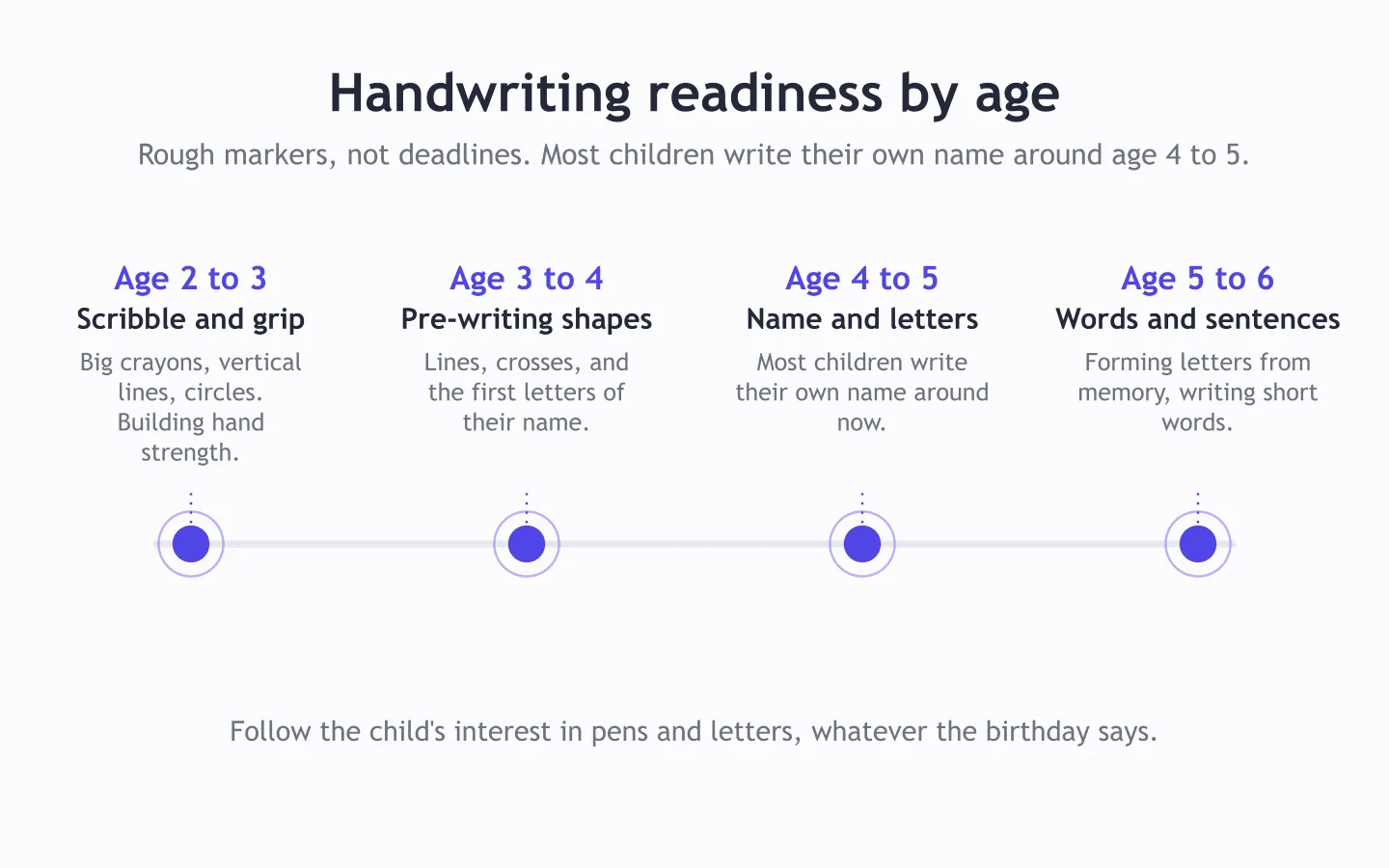
Parents ask this a lot, and the honest answer is that age is a poor guide on its own. Two 4-year-olds can be a year apart in hand control. What you want to watch is readiness, not the calendar. A dynamic tripod grip, the mature three-finger hold most adults use, typically develops between ages 4 and 7, and that grip is a big part of being ready to write.
What is the best age to start handwriting?
There is no single right age, but most children start forming letters between 4 and 6. Before that, from about age 2 to 4, the work is pre-writing: scribbling, drawing lines, and copying shapes like circles and crosses. Push formal letters too early and a child gets frustrated by a task their hand cannot do yet. Wait for the hand to catch up, and letters come far easier.
What skills come before writing letters?
Letters are made of a small set of strokes, so kids practice the strokes first. The usual order is vertical lines, then horizontal lines, then circles, then crosses and diagonals. Most children can copy a circle around age 3 and a cross around age 4. Once your child can draw these basic shapes, they have the building blocks for letters.
- Vertical and horizontal lines (the strokes in L, T, and E).
- Circles and curves (the strokes in O, C, and a).
- Crosses and diagonals (the strokes in X, K, and A).
- A grip that lets the fingers move the pencil, not the whole arm.
How do I know my child is ready to write?
Look for hand control and interest together. A child who is ready can hold a crayon with their fingers rather than a fist, copy simple shapes, and sit with a task for a few minutes. Interest matters as much as ability. A child who reaches for pens and asks what words say is telling you they are ready, even if their letters are wobbly at first.
How should we start, once a child is ready?
Start with tracing, big and slow. Tracing gives the hand a path to follow, so a child feels a correct letter before making one. Begin with the letters in their own name, since those mean the most. Then work through the alphabet a few letters at a time.
- Print a tracing worksheet with large letters and clear guide lines.
- Trace each letter together, talking through where the stroke starts.
- Let your child trace it alone, then write it on the blank line.
- Keep sessions to a few minutes. Stop before they get tired.
The free name tracing generator is a good first step, since it builds a worksheet from your own child's name. For the full alphabet, the printable handwriting practice sheets cover A to Z on the same trace-then-write layout.
Make a name tracing worksheet
Type a name, pick a font, and print a free tracing sheet to practise with.