How to teach a child to write their name
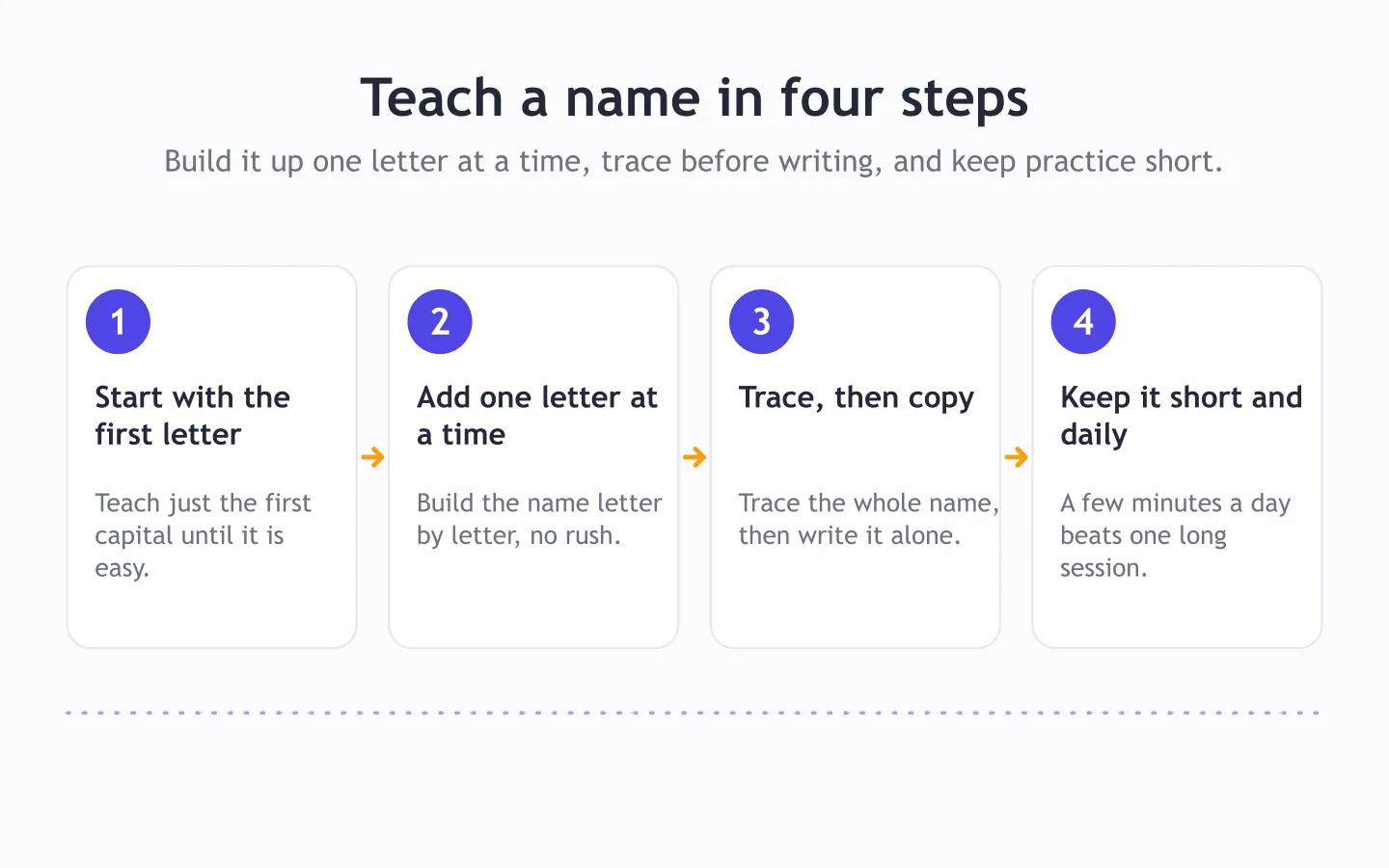
Start with the first letter, then add the rest one at a time. Write the name in capitals first, since straight lines and simple curves are easier for small hands than lowercase. Keep practice short, a few minutes a day, and let your child trace the name before writing it alone.
A name is the first word most kids ever write, and it carries weight. A study published in the NIH library found that how well a preschooler writes their name links to their early reading and writing skills, more than the length of the name does. So this is worth getting right, and worth keeping fun.
Here's a plan that works for tired parents and busy teachers. No drilling, no tears.
What age should a child write their name?
Most kids can write their own name around age 4, though plenty do it earlier and plenty later, and both are fine. By age 3 many children recognize the first letter of their name. By 5 or 6 they can usually write it without help. Treat these as rough markers, not a deadline. A child who shows interest in pens and letters is ready, whatever the birthday says.
Should I teach capital or lowercase letters first?
Teach the name in capital letters first. Capitals are built from straight lines and simple curves, which are easier for small hands to control than the loops and tails of lowercase. Once your child can write the name in capitals, move to the normal mix: one capital at the start, lowercase for the rest. That is how their name will look on everything from now on.
How do I teach name writing step by step?
Build the name one letter at a time, and trace before you write. Tracing teaches the hand the shape and the stroke order before the child has to make the letter from scratch. Here is the routine:
- Say the name and point to each letter. Let your child hear and see the letters in order.
- Start with the first letter only. Trace it together a few times, then let them try it alone.
- Add one new letter at a time. Do not move on until the last one feels easy.
- Trace the whole name on a worksheet, then write it on the blank line below.
- Praise the effort and the tricky letters, not just the neat ones.
A traceable worksheet makes this far easier than a blank page. Type the name into the free name tracing generator, print it, and your child traces their real name in a handwriting font, as many rows as you want.
How much name practice does a child need?
Short and often beats long and rare. A few minutes a day, most days, does more than a half-hour session once a week. Young hands tire fast, and a long sit-down turns practice into a fight. Stop while your child is still enjoying it. End on a win, even a small one.
Quick tips that help
- Use big letters at first. Small writing needs fine control that comes later.
- Let them trace with a finger before a pencil. The movement sinks in either way.
- Keep the same spelling and the same letter shapes every time, so nothing competes.
- If a letter keeps coming out backwards, slow down and fix the starting point, not the whole letter.
If your child reverses letters like b and d, that is normal at this age. Our guide on b and d reversals explains when it sorts itself out and what to do if it sticks around.
Make a name tracing worksheet
Type a name, pick a font, and print a free tracing sheet to practise with.