Fine motor skills activities that make handwriting easier
Handwriting starts in the hand, not on the page. Activities like rolling playdough, picking up pompoms with tweezers, pinching clothespins, and threading beads build the strength and finger control a pencil demands. Ten to fifteen minutes of this kind of play a day does more for a young writer than extra worksheets, because it trains the muscles the letters depend on.
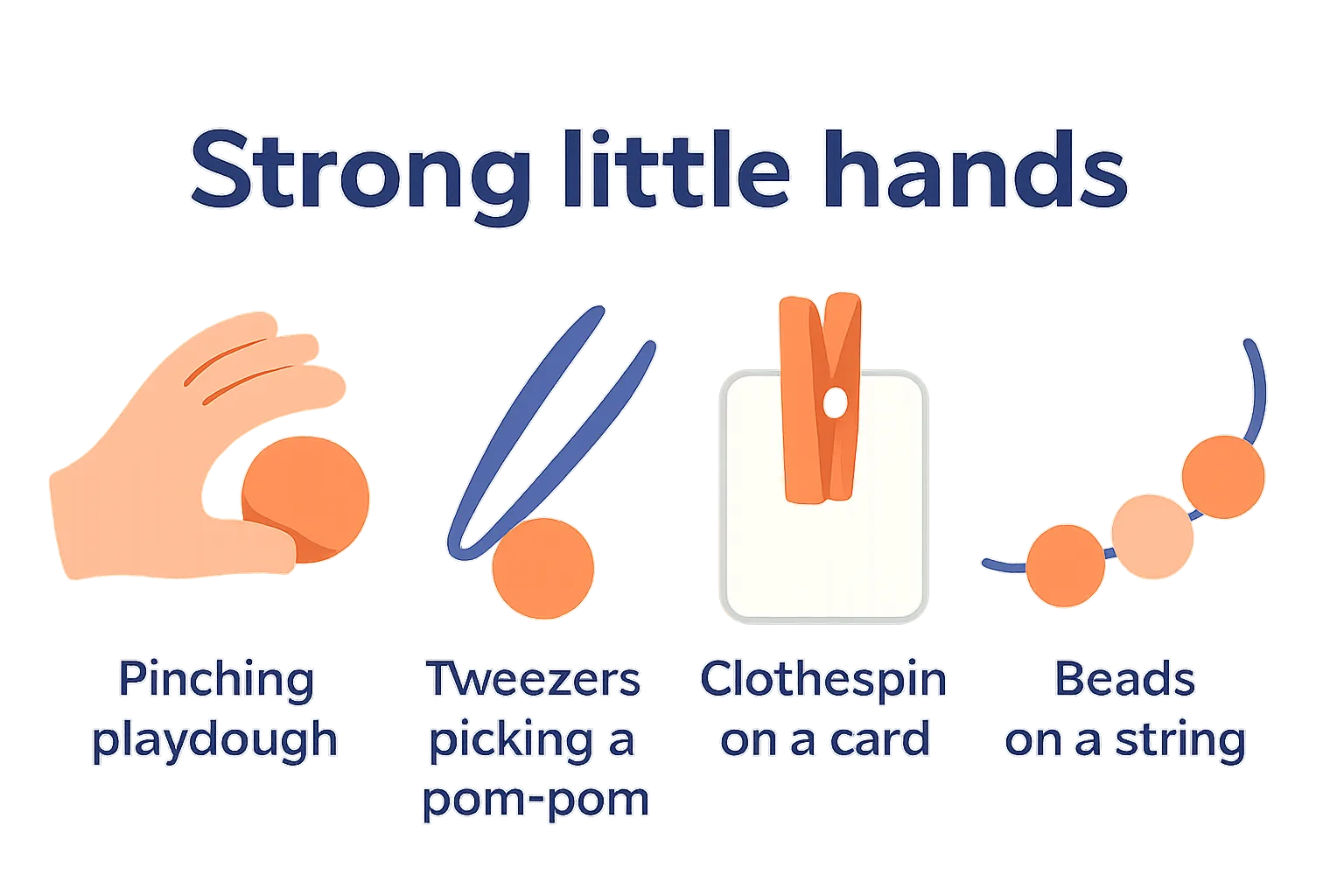
When a child's letters are shaky, the problem is often below the pencil. Writing trouble is common, with studies estimating that somewhere between 5 and 25 percent of school-age children struggle with it. The encouraging part is how well targeted play works. In a 2020 study published in the NIH library, ten weeks of short, small-group fine motor games measurably improved kindergartners' visual-motor skills, and the children who started furthest behind gained the most.
You do not need a therapy clinic to run that kind of program at home. Most of it comes down to playdough, a few kitchen items, and a little structure. Here is what each activity builds and how to string them into a short daily routine.
Why do fine motor skills matter for handwriting?
Because writing is a fine motor task before it is a language task. Forming a letter means pinching the pencil with enough strength to control it, moving it with the fingertips rather than the whole arm, and steadying the paper with the other hand. A child without that strength and control grips too hard, tires fast, and writes big wobbly letters no matter how well they know the alphabet.
A few specific skills carry most of the load. The pinch between thumb and index finger holds the pencil. The ring and pinky fingers curl into the palm to steady the hand, so the two sides of the hand learn different jobs. Small movements shift things around within the hand, the way you walk a coin from your palm to your fingertips. And the two hands learn to cooperate, one working while the other holds. Every activity below feeds at least one of these, and that is exactly why they transfer to the pencil.
Which activities build hand strength?
Anything that makes the hand squeeze, pinch, or press against resistance builds strength. Playdough is the classic for a reason: it resists every movement, so five minutes of play is a full hand workout. Rotate through a few of these rather than repeating one, since different grips work different muscles.
- Playdough. Squeeze it, roll snakes with both palms, flatten it, and pinch off pea-sized pieces with thumb and index finger. Hide coins or beads inside and have your child dig them out for extra finger work.
- Clothespins. Pinching a clothespin open uses the same thumb-and-finger pinch that holds a pencil. Clip pins around the edge of a paper plate, or hang doll clothes on a string line.
- Spray bottles. Pulling the trigger strengthens the whole hand and the index finger in particular. Let your child water plants or spray shapes onto the pavement on a warm day.
- Hole punches. Punching through paper takes real squeeze strength. Punch holes around a drawn shape, then thread yarn through them for a two-in-one activity.
- Tearing paper. Ripping old magazines into strips and scrunching them into balls works the fingers of both hands. Glue the pieces into a collage so the effort makes something.
- Tongs and turkey basters. Moving cotton balls with kitchen tongs, or racing them across the table with puffs from a baster, builds squeeze strength inside a game.
Which activities build finger control and dexterity?
Strength moves the pencil, but control aims it. These activities ask for precision: small objects, small targets, and movements that come from the fingertips. They tend to suit a calm moment better than a wild one, so save them for after the squeezing games have burned off some energy.
- Tweezers and pompoms. Sorting pompoms into the cups of an egg carton with tweezers rehearses the exact three-finger grip a pencil uses, one pickup at a time.
- Stringing beads. Threading needs both hands doing different jobs, one holding the string steady while the other aims the bead. Start with chunky beads and thick laces, then shrink them as skill grows.
- Pegboards. Placing pegs into small holes trains the pinch and the aim together. Copying a simple pattern from a card adds looking-then-doing, the same loop handwriting runs on.
- Coins into a slot. Drop coins into a piggy bank, or a slit cut in a shoebox lid. For a harder version, have your child hold three coins in their palm and feed them to their fingertips one at a time without using the other hand.
- Stickers. Peeling a sticker off a sheet isolates the fingertips like almost nothing else. Peel and place stickers along a drawn line or inside a shape for aim practice too.
- Lacing cards. Sewing a lace in and out of punched holes combines threading, aim, and two-handed work. A cheap set lasts for months of practice.
Notice that both hands are busy in most of these. That is deliberate. Writing is a two-handed job, with one hand steering the pencil while the helper hand pins the paper. Threading, lacing, tearing, and cutting with child-safe scissors all train the hands to hold different roles at the same time, which is why kids who do lots of this kind of play tend to settle at a desk more easily.
Which everyday jobs count as fine motor practice?
Most of them. Buttons, zips, jar lids, and snack wrappers give the fingers the same workout as any planned activity, and they arrive with built-in motivation, because the child wants the shoe on or the snack open. Doing these jobs for your child is faster. Letting them do it themselves is the practice.
- Getting dressed. Buttons, zips, snaps, and shoelaces are all precision work. Leave five spare minutes in the morning so your child can manage them without anyone swooping in.
- Kitchen help. Kneading dough, tearing lettuce, peeling a mandarin or a boiled egg, and spreading butter with a small knife mix strength and control in a job that ends with food.
- Opening things. Screw-top jars, lunch containers, and zip-top bags take a strong pinch and two hands working together. Hand them over instead of handing them back opened.
- Tidy-up games. Posting small toys one at a time into a narrow-necked container turns cleanup into aim practice, and beating yesterday's time turns it into a game.
These jobs do not replace a short routine, but they multiply it, because they scatter dozens of small pinches and squeezes through an ordinary day. A child who dresses themselves and helps in the kitchen is doing fine motor work before breakfast.
What does a 10 to 15 minute home routine look like?
Pick one strength activity and one precision activity, bookend them with a warm-up and a couple of minutes of pencil work, and you have a routine that fits between snack and dinner. Short and regular beats long and occasional, because small muscles strengthen through frequent light use, the same way they do for adults.
- Warm up for a minute or two with playdough: squeeze it, roll a snake, pinch a row of little pieces off the end.
- Do one strength activity for about five minutes, like clothespins around a plate or a spray bottle job.
- Do one precision activity for about five minutes, like tweezers and pompoms or a lacing card.
- Finish with two or three minutes of pencil work, tracing a few letters or their name, so the fresh strength lands on the page.
Rotate the middle two slots through the week so nothing gets stale, and follow your child's lead when something catches on. If the beads become an obsession, let them be. The routine is a menu, not a syllabus, and the whole thing should feel like play with a tidy finish, never like homework.
That last step is where the transfer happens, so keep it tiny and easy. Print a sheet from the free name tracing generator so your child ends each session tracing their own name, or pull a page from the printable handwriting practice sheets and trace two or three letters. If the pencil hold itself looks awkward during that step, our guide on how to hold a pencil covers the tripod grip and the quick fixes.
Give it a few weeks before you judge the results. In the NIH study above, the program ran for ten weeks, and the gains showed up across that span, especially for the kids who started weakest. Hands change on the same schedule as any other muscle: gradually, then obviously.
One last note. If your child avoids all drawing, building, and hands-on play, cannot manage buttons or beads long after friends can, or their hand tires within a minute of any fine work, mention it to their teacher or pediatrician. A pediatric occupational therapist can check whether something specific is in the way. For most kids, though, the gap is plain lack of practice, and the activities on this page close it.
Make a name tracing worksheet
Type a name, pick a font, and print a free tracing sheet to practise with.