What to do when your child refuses to write
When a child refuses to write, lower the stakes before you add practice. Refusal is almost always a signal: the task feels too hard, too boring, or too risky to get wrong. Shrink sessions to a couple of minutes, switch to writing with a purpose, like cards and shopping lists, and check the simple physical causes. If writing stays painful or far behind peers, ask about an occupational therapy evaluation.
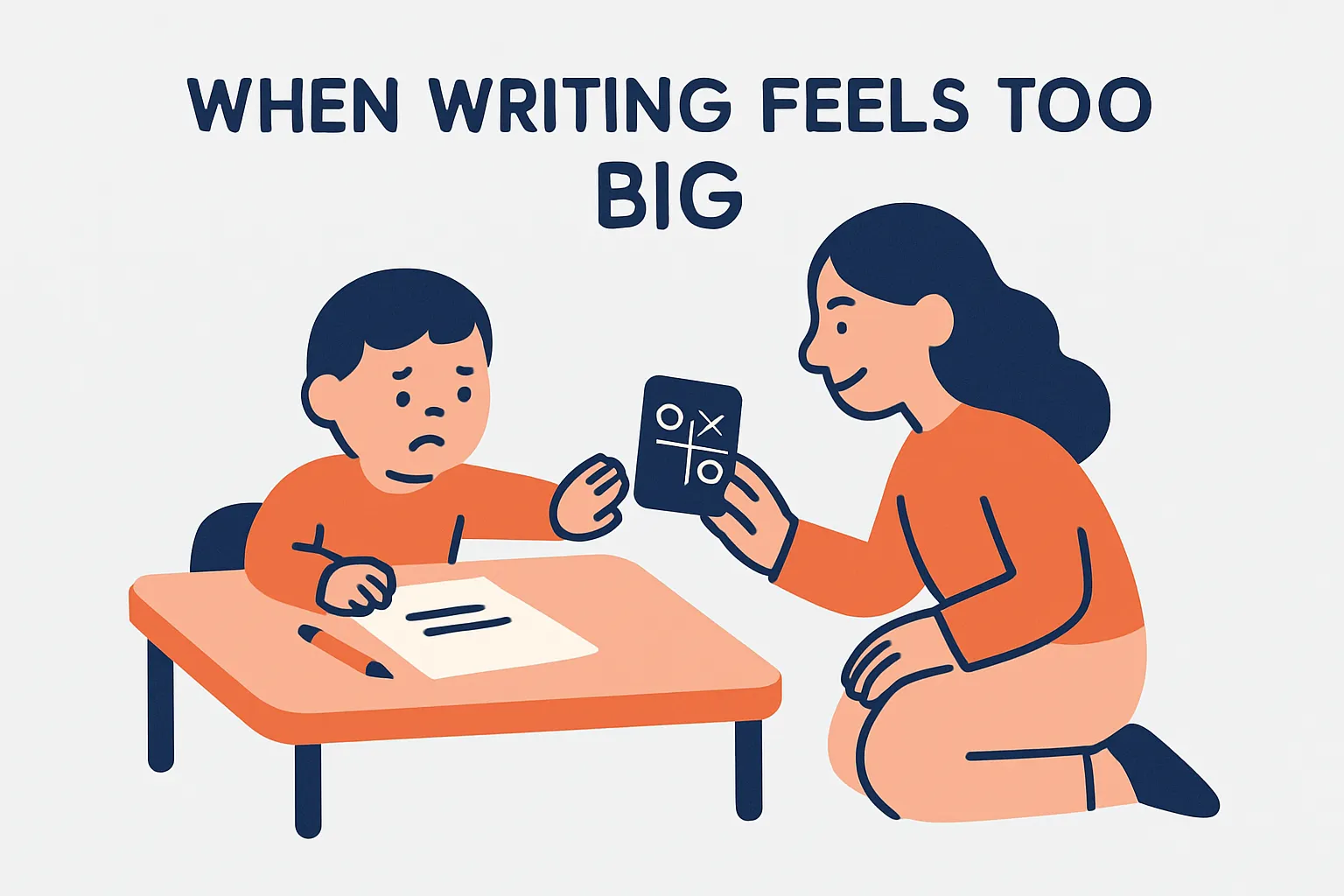
First, some perspective: a child who refuses to write is not broken, and neither is your parenting. Writing is genuinely hard work for young hands, and school serves a lot of it. When researchers Kathleen McHale and Sharon Cermak observed elementary classrooms, they found students spent 30 to 60 percent of the school day on fine motor tasks, with writing making up most of that time. A child who finds writing tiring or embarrassing has to sit with that feeling for a big slice of every single day. Seen that way, refusing is often the most sensible move a kid can think of.
So treat refusal as information rather than defiance. Something about writing is costing your child more than it seems to cost other kids, and your job is to find out what. Here is how to read the signal, what to rule out first, and how to make the way back in feel safe.
Why does my child refuse to write?
Almost every case traces back to one of five causes: the work is physically too hard, it feels pointless, the child is afraid of getting it wrong, they are simply worn out, or an underlying difficulty is making writing cost far more effort than it should. Notice when the refusal shows up, and it will usually point to which one you are dealing with.
- Too hard: the hand tires within minutes, the grip goes white knuckled, and the complaints sound physical. "My hand hurts" is data, not drama.
- Boring: worksheets get an eye roll, but the same child happily writes a menu for a pretend restaurant. The skill is there. The point of it is missing.
- Fear of mistakes: the child writes a letter, scowls at it, erases it, and quits. Perfectionists often refuse whatever they cannot yet do neatly.
- Fatigue and timing: refusal that only appears at 4 pm after a full school day is about an empty tank, not about writing.
- An underlying difficulty: a small number of kids resist because something specific, like weak hand strength or trouble recalling letter shapes, makes writing far harder for them than for classmates.
Where the refusal happens is a clue as well. A child who refuses only at home may have spent all their writing stamina at school hours earlier. A child who writes happily at home but shuts down in class may feel watched or rushed. And a child who refuses everywhere, every time, is carrying something heavier than a mood, which is what the rest of this guide is for.
What should I rule out before anything else?
Check the cheap and simple things first: the setup, the tools, the timing, and your own expectations. A surprising share of writing battles end when the chair fits, the pencil stops hurting, or the ask shrinks to something age appropriate. Run down this list before you conclude anything bigger.
- The setup: feet flat on the floor, table around elbow height, paper held steady. A dangling, twisting child cannot control a pencil.
- The tools: a sharpened pencil of the right size, or a chunky crayon that fits the hand. If the grip looks strained or painful, our guide on how to hold a pencil covers gentle fixes.
- The timing: not straight after school and not right before bed. After a snack and some running around works far better.
- The ask: a 4 year old told to write sentences will refuse, and should. Check that the task matches the age, not the neighbor kid.
- Vision: if your child squints, tilts their head at the page, or leans in very close, mention it at the next checkup before blaming motivation.
Fix whichever of these apply, then wait a week or two before drawing bigger conclusions. A changed setup needs a little time to show up in behavior, because your child has to trust that writing time really is different now. Quiet consistency convinces kids faster than any announcement does.
How do I get my child writing again without a fight?
Shrink the task until it is almost silly, then give writing a real job. A reluctant writer will refuse a worksheet, but the same child will often write three words that actually do something, like a sign for their bedroom door or "pizza" on the shopping list. Purpose changes everything, and a tiny task is hard to say no to.
Give writing a job
- The shopping list: your child owns one line of it. If a treat is not written down, it does not get bought, so "gummy bears" suddenly matters.
- Cards and notes: birthday cards, thank you notes, or a lunchbox note that asks for a note back.
- Labels and signs: name tags for stuffed animals, a KEEP OUT sign, labels for the toy bins.
- Menus and tickets: a menu for the pretend restaurant, tickets for tonight's living room show.
- Treasure hunts: you write a clue, they write the next one, and the writing takes turns with the finding.
Lower the stakes
- Change the surface: a whiteboard, chalk on the driveway, a steamed up mirror, a window marker. Erasable surfaces quiet the fear of mistakes.
- Use the two minute rule: writing time ends after two minutes unless your child asks to keep going. Ending early is the point, so keep the promise.
- Write together: you write a word, they write a word. Your ordinary adult wobbles give them permission to be imperfect.
- Praise one thing: pick their best letter and say exactly why it is good. Skip the corrections entirely for now.
- Never use writing as a punishment, and keep it out of bargains over screens or dessert. Writing must not become the enemy.
Notice what is missing from those lists: worksheets, drills, and anything called practice. That is deliberate. Once the fear fades and small purposeful writing feels normal, usually after a few weeks, structured practice can return in short doses. Our guide on how long handwriting practice should be covers what those doses look like, and the multisensory activities guide has more ways to keep letters playful, like salt trays and finger tracing.
When should I ask about an occupational therapy evaluation?
Ask when the refusal is intense, has lasted months despite a genuinely low pressure approach, and comes with physical signs: complaints of hand pain, a fist grip well past age 6, letters a stranger cannot read, or a child who avoids drawing and coloring and cutting too. Any one of those alone can be normal. A cluster that will not budge deserves a professional look.
- Writing seems to genuinely hurt, and the complaints show up everywhere, not only at homework time.
- Your child avoids every fine motor activity: no drawing, no coloring, no puzzles, no building toys.
- The grip is still a whole hand fist well past age 6, or the pencil is steered from the shoulder and elbow instead of the fingers.
- There is a wide, obvious gap between your child and classmates, and the teacher has noticed it too.
- Refusal looks like real distress, with tears or panic, rather than ordinary grumbling.
Start with the classroom teacher, who sees your child next to twenty age mates every day and can tell you honestly whether the gap is real. In many school systems the teacher can also start a referral to a school occupational therapist at no cost to you. An evaluation is not a label. It is an hour or so of careful observation that either rules a problem out or gets your child targeted help early, and early help is far easier than catching up in third grade.
None of this replaces your pediatrician, and a guide on the internet cannot see your child. If your gut says something is off, say it out loud to the professionals around them and ask directly what they would check. Parents who ask early tend to be glad they did, whichever way the answer comes back.
When your child is ready to try letters again, start with the one word that carries no fear: their own name. Type it into the free name tracing generator and print a page they can trace in under a minute, with no blank page staring back at them. The printable handwriting practice sheets work the same way for the rest of the alphabet, one traced row at a time, whenever they ask for more. Let them ask. Getting asked is how you know the turnaround worked.
Make a name tracing worksheet
Type a name, pick a font, and print a free tracing sheet to practise with.