How long should handwriting practice be?
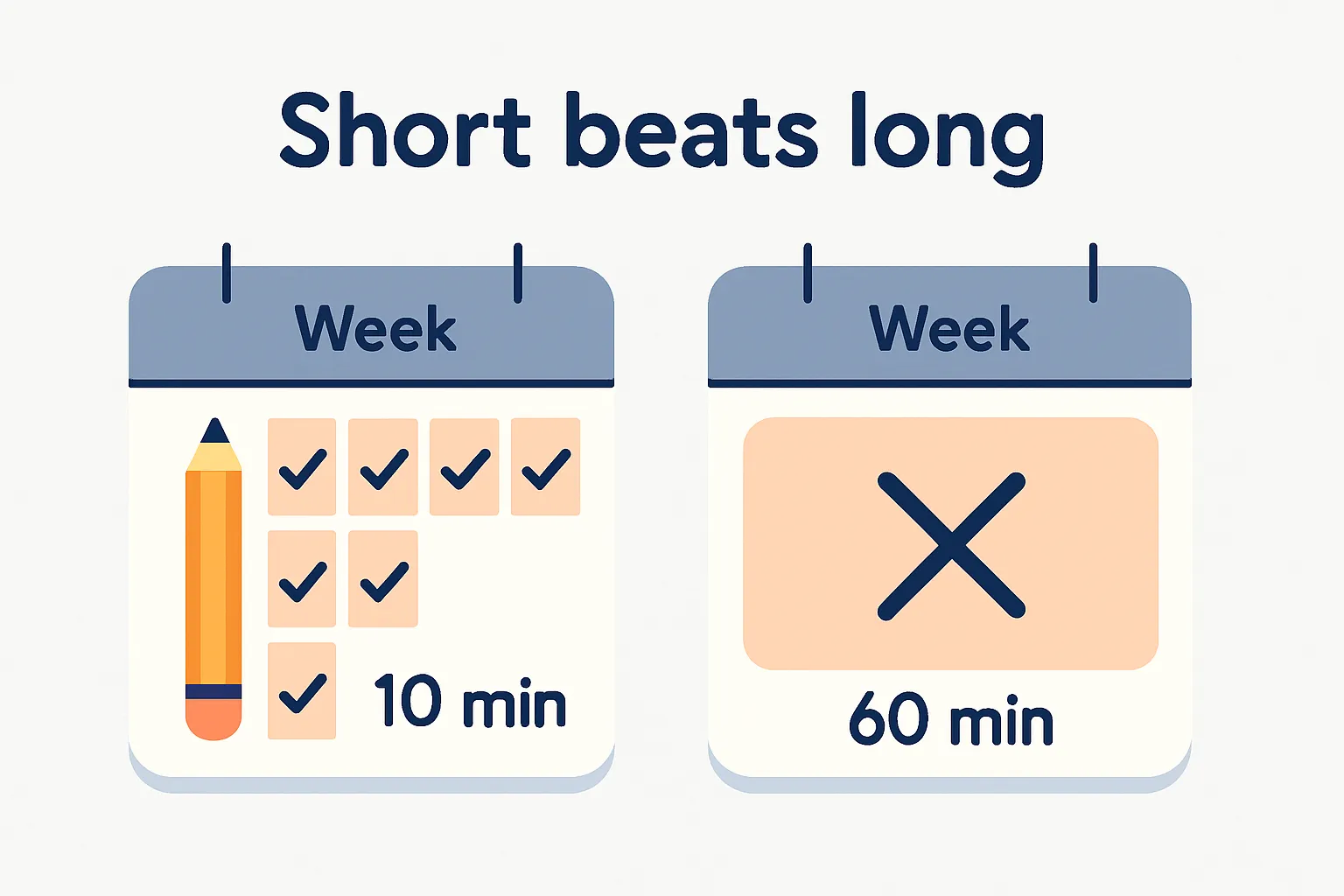
Keep handwriting practice short: around five minutes a day at ages 3 to 4, ten minutes at ages 5 to 6, and fifteen at most for ages 7 to 8. Frequency matters more than length. Five short sessions spread across a week teach more than one long Saturday sitting, because young hands tire fast, and a tired hand rehearses sloppy letters. Stop at the first signs of fatigue.
Parents usually worry that a few minutes of practice cannot possibly be enough. The research is reassuring. In 2016, Tanya Santangelo and Steve Graham pooled the results of dozens of experiments on teaching handwriting and found that children who got direct instruction wrote more legibly and more fluently than children who did not. The gains reached past neatness, too: taught kids went on to produce longer and better writing overall. So deliberate practice clearly pays. The open question for a parent is the dose. How much can a young hand actually use in one sitting? Less than most adults expect, and far less than most workbooks imply.
This guide covers how long sessions should run at each age, why daily beats weekly, how to spot a tiring hand before the letters fall apart, and what a good 5, 10, or 15 minute session actually looks like.
How long should handwriting practice be at each age?
About five minutes of focused pencil work for ages 3 to 4, around ten minutes for ages 5 to 6, and ten to fifteen minutes for ages 7 to 8. Those numbers count only the concentrating part, when your child is tracing or forming letters with attention. Warm-ups, chat, and drawing for fun ride along free and use none of the budget.
- Ages 3 to 4: about 5 minutes. The hand muscles are still developing, and attention runs out at roughly the same time the hand does.
- Ages 5 to 6: about 10 minutes. Enough for a warm-up, a few rows of letters, and one real word at the end.
- Ages 7 to 8: 10 to 15 minutes. Older kids can hold focus longer, but past the 15 minute mark, the value of each extra minute drops fast.
Treat these as ceilings for practice you ask for, not limits on writing your child chooses. A kid who begs to finish a story or add one more row is telling you the session is working, so let them run. The numbers exist to stop adults from over-scheduling, not to stop children from writing. And if your child taps out at three minutes instead of five, that is fine too. Their honest capacity today is the right size for today.
Is it better to practice a little every day or a lot once a week?
A little every day wins, and it is not close. Ten minutes on five days teaches more than fifty minutes on Saturday, even though the totals match. Psychologists call this the spacing effect, one of the oldest and most repeated findings in learning research: practice spread across days sticks better than the same practice packed into a single sitting.
Handwriting gets an extra boost from spacing because it is a motor skill. The brain strengthens new movement patterns between sessions, especially during sleep, the same way it settles piano scales or a tennis swing. Each short session lays down a thin layer, and the gap afterward lets that layer set. A marathon session mostly piles repetitions onto a hand that stopped learning twenty minutes in.
Daily also keeps the emotional cost low, which decides whether practice happens at all. A five minute routine is easy to say yes to, so it survives busy weeks. A long weekly block is easy to dread, easy to postpone, and easy to fight about, so it quietly dies by November. If you have to choose between short and daily or long and rare, short and daily wins every time.
When is the best time of day for handwriting practice?
Whenever your child is fed, rested, and not mid-collapse, which for most school kids rules out the minutes right after pickup. Late afternoon, after a snack and some running around, works well for many families, and so does the relaxed stretch of a weekend morning. The two worst slots are straight off the bus and right before bed.
More useful than finding the perfect hour is keeping the same hour. Attach practice to a fixed anchor, like right after snack, or right after teeth for an older child, and the daily negotiation disappears. When practice is simply the thing that happens after snack, nobody has to decide anything, and deciding is where most battles start.
How do I know when my child's hand is getting tired?
Watch the writing, not the clock. A tiring hand announces itself a minute or two before a child complains, and the page shows it first. Letters swell or start to slant, spacing goes ragged, the grip creeps up the pencil or clamps into a fist, and the whole body begins sagging toward the desk.
- Letters suddenly grow, wobble, or drift off the line after a neat start.
- The grip tightens, or the fingers slide up and down the pencil between letters.
- Your child shakes out the hand, swaps hands, props up their head, or lies over the table.
- Silliness, sighing, and sudden urgent needs for water, a snack, or the bathroom.
Stop at the first sign, ideally right after a good letter, so the session ends on a win. Pushing through is worse than stopping, because a fatigued child rehearses malformed letters with a strained grip while learning that writing feels bad, and all three of those lessons stick. Ending early is protecting the habit, and the habit is the whole game.
What does a good 5, 10, or 15 minute session look like?
Good sessions share one skeleton: a short warm-up, one clear focus, and an easy finish that ends on success. Here are three shapes to borrow, sized by age.
The 5 minute shape, ages 3 to 4
- One minute: wake up the hand. Squeeze play dough, crumple scrap paper, or draw one huge letter in the air with a finger.
- Three minutes: trace one or two letters, big, on a worksheet. One letter done slowly and well beats five done fast.
- One minute: the victory lap. Your child picks their best letter and you circle it together.
The 10 minute shape, ages 5 to 6
- Two minutes: warm up with an easy row of something they already do well.
- Five minutes: the focus. Trace a row of the target letter, then write the same letter on the blank line without the guide.
- Two minutes: something real. Their name, a pet's name, or one word they choose themselves.
- One minute: they pick the best letter on the page and tell you why it won.
The 15 minute shape, ages 7 to 8
- Three minutes: copy one sentence at a comfortable pace to warm up.
- Five minutes: focused work on the two or three letters that keep going wrong.
- One minute: stand up, shake out the hands, get a drink.
- Five minutes: purposeful writing, like a card, a list, or a caption under a drawing.
- One minute: compare today's best letter with last week's version and admire the difference.
The break in the middle of the 15 minute shape is load bearing. Without it, the second half slides into exactly the tired, sloppy repetitions the whole plan is built to avoid.
What if we miss days or my child quits early?
Shrug and restart tomorrow. Four or five short sessions a week is plenty, and a broken streak costs nothing as long as the routine comes back. On rough days, shrink the session instead of skipping it: one traced letter and done still counts. What kills progress is never the missed Tuesday. It is the guilt spiral that turns a missed Tuesday into a missed month.
Apply the same mercy inside a session. Ending two minutes early with a good letter on the page beats squeezing out two more minutes of scrawl. Extra practice only helps when it is good practice, and a young hand holds maybe ten good minutes at a time. When the good minutes are spent, the session is over, whatever the timer says.
Short sessions only work if the materials are ready before the mood arrives, so the setup cannot eat the practice. Keep a small stack from the printable handwriting practice sheets in one spot with a sharp pencil, or print a page from the free name tracing generator, since a child's own name is the word they will practice most willingly. And if practice at any length has already turned into a standoff, start with our guide on what to do when a child refuses to write, and fix the mood before the minutes.
Make a name tracing worksheet
Type a name, pick a font, and print a free tracing sheet to practise with.