What order to teach letters for writing (hint: not A to Z)
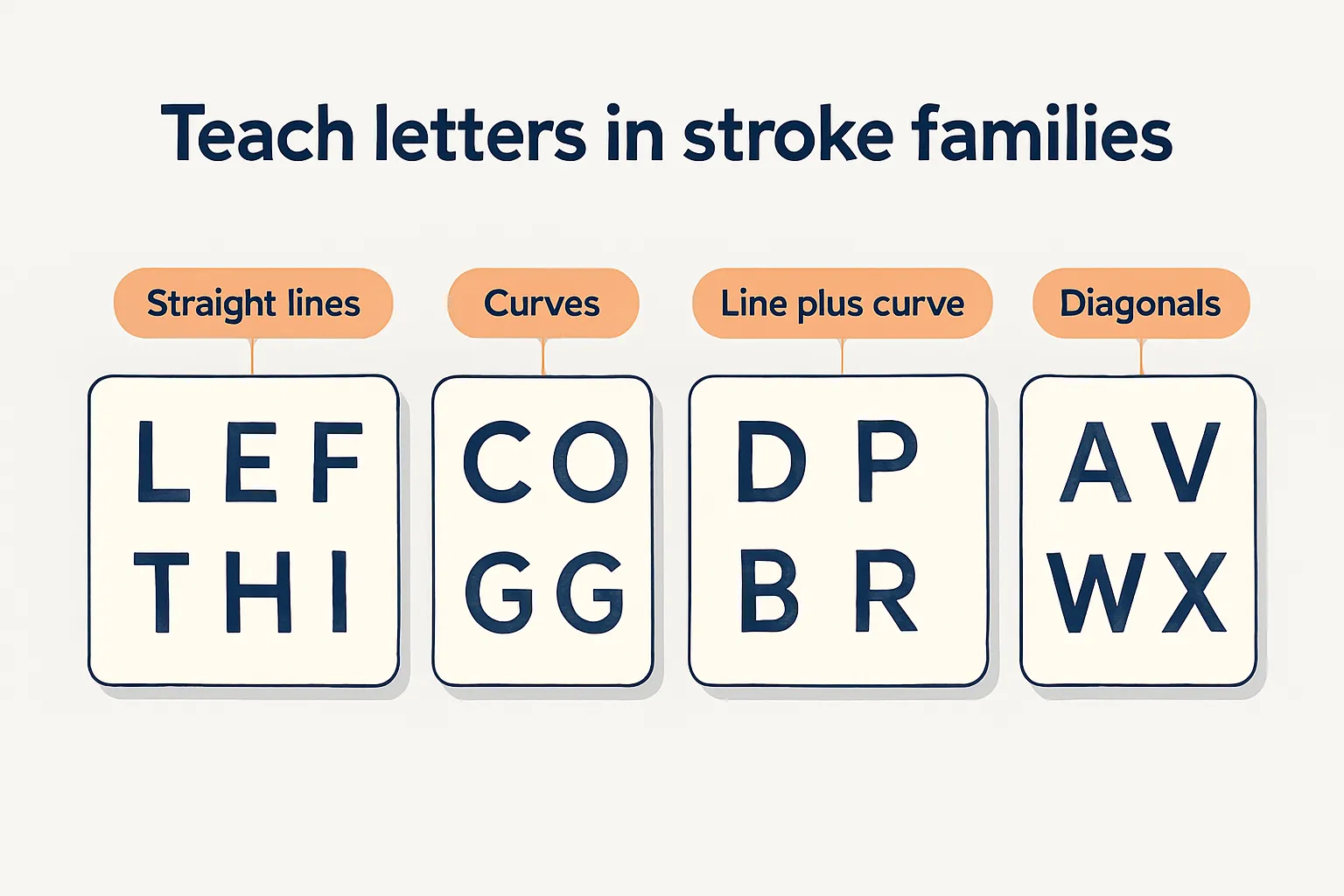
Teach letters for writing in stroke families, not from A to Z. Start with straight-line capitals like L, T, I, E, F, and H. Move on to curve letters like C, O, Q, and G, then letters that mix lines and curves like D, P, B, and R, and save diagonal letters like K, M, N, and W for last. Capitals come before lowercase.
The alphabet song puts the letters in a fine order for singing and a poor one for writing. Researchers at Florida State University tested hundreds of preschoolers on how well they could write each letter, and difficulty turned out to be scattered all over the alphabet. O, L, A, and T were among the easiest letters for young children to write, while J, K, Z, G, and Q were among the hardest. March through the letters alphabetically and a beginner hits easy and hard letters at random, with no chance to build one movement on top of another.
Grouping letters by the strokes they share fixes that. It is how occupational therapists and most handwriting programs sequence the alphabet, and it is easy to run at home. Here is the case against A to Z, the order that works better, and how to teach each group.
Why is alphabetical order the wrong order for writing?
Because writing is a motor skill, and motor skills are learned from easy movements to hard ones, with similar movements taught together. Alphabetical order ignores both rules. It opens with A, a diagonal letter many 4-year-olds cannot control yet, jumps between straight, curved, and slanted strokes with every letter, and never lets one letter make the next one easier.
To be clear, A to Z is fine for what it was built for: the song, letter names, and learning to recognize letters on the page. Keep singing it. This guide is about something narrower, the order in which a child learns to form letters with a pencil, and for that job the alphabet's order is an accident of history, no more meaningful than teaching words in dictionary order.
Think about how anything else physical gets taught. A swim coach does not teach the strokes in dictionary order, and a piano teacher does not start with whichever piece begins with A. They order the work so each skill feeds the next. Stroke families do that for letters: a child who has just written L has already practiced most of T, and a child who can write C is one stroke away from O and G. Alphabetical order throws that free progress away.
There is a bonus for often-confused letters, too. In a stroke-family sequence, lowercase b and d land in different groups and get learned weeks apart, so each one is solid before the lookalike shows up. Taught back to back, as the alphabet lines them up, they blur together. If that mix-up has already taken hold, our b and d reversal guide has the fixes.
What order should I teach the letters in?
Work through four capital-letter groups, from the easiest strokes to the hardest: straight lines first, then curves, then letters that combine a line with a curve, then diagonals. Within each group, put the letters with fewer strokes first. Here is the sequence:
- Straight-line letters: L, T, I, H, E, F. Every stroke is a vertical or horizontal line, the first strokes children master. Big line down, little line across, done.
- Curve letters: C, O, Q, G, S. These grow out of the circle. C is a circle left open, O closes it, Q and G add a small line, and S saves its double curve for the end of the group.
- Line-plus-curve letters: D, P, B, R, U, J. Each starts with a familiar straight line and hangs a curve on it. B follows P naturally, since it is a P with a second belly.
- Diagonal letters: A, K, M, N, V, W, X, Y, Z. Slanted strokes are the last ones young hands control, usually around age 5, so these letters come last even though A and K sit near the front of the alphabet.
Two practical notes. First, your child's name jumps the queue. The letters in a name carry more motivation than the rest of the alphabet combined, so teach them early no matter which group they belong to, the way our guide on teaching a child to write their name lays out. Second, treat the groups as a path, not a prison. If your child is desperate to write the M in Mom, teach it. Then come back to the path.
Where does lowercase fit into the order?
The same family logic orders the lowercase letters when your child gets there, typically once the capitals are steady. Teach c first, because it opens the biggest family: c, o, a, d, g, and q all begin with the same curve. Then the short straight-line letters l, t, and i. Then the letters that start with a line down and add a bump, like r, n, m, h, b, and p. The tail letters and diagonals, like j, y, k, v, w, x, and z, come last. Notice that d sits in the c family and b sits in the bump family, which is exactly the separation that keeps them from blurring together.
Should I teach capitals or lowercase first?
Capitals first, for writing. Capital letters are built from big, separate strokes, they all stand the same height, and every one starts at the top. Lowercase letters are harder on every count: they mix curves and tails, sit at three different heights, and include the mirror pairs b and d, p and q. Master the simple set first, then reuse those movements on the harder one.
Children vote the same way with their own pencils. In the Florida State study, when preschoolers wrote letters, about 94 percent of what they produced came out as capitals, even when nobody asked for them. Starting formation practice with capitals goes with that grain instead of against it. Lowercase still matters enormously, since almost everything your child will read and write is lowercase, and school will expect it. The point is sequence: capitals are the on-ramp, and the same stroke-family logic then orders the lowercase letters when your child is ready for them.
One practical caveat: if your child's school has already started them on lowercase, follow the school. Matching the classroom matters more than running the ideal sequence at home, and everything on this page still applies. The lowercase families above give you the order, and the teaching routine below works the same for any letter, big or small.
How do I teach one letter group?
One letter at a time, starting at the top, with the same short verbal cue every time. A cue like "big line down, little line across the top" for T gives your child words to steer the pencil by, and saying it aloud while they write keeps the stroke order consistent. Consistency is most of the battle: a letter formed the same way every time becomes automatic, and automatic letters free the child's attention for spelling and ideas later.
- Show the letter and draw it slowly yourself, saying the cue as you go.
- Have your child trace it several times, big, while saying the cue with you.
- Let them write it alone on a blank line, still starting at the top.
- Add the next letter in the group only when the current one comes out steadily without help.
- When the group is done, review it by writing all its letters in a row, then mix in a letter from an earlier group so nothing fades.
Mistakes worth avoiding
- Letters formed from the bottom up. Bottom-starting letters look fine at age 5 and become slow, laborious writing at 8. Catch the start point early, every time.
- Mixed models. If school teaches a particular letter style, use the same one at home. Two competing versions of the letter a will fight each other.
- Too many new letters at once. One new letter per session is plenty. The goal is automatic letters, and automatic takes repetition.
- Correcting everything. Fix the start point and the stroke order, and let wobbles go. Wobbles fade with practice. A child who hears only corrections stops wanting to write.
A traceable model does half of this for you, since the letter is already there to follow. The printable handwriting practice sheets cover the full alphabet on a trace-then-write layout, so you can pull out the pages for whichever group you are on. For name letters, the free name tracing generator builds a sheet from your child's own name in seconds. Expect a group to take a week or two of short sessions, and expect the diagonal group to take the longest. That is the strokes, not the student.
Make a name tracing worksheet
Type a name, pick a font, and print a free tracing sheet to practise with.