Is tracing good for learning to write?
Yes, tracing helps, but only as a first step. Tracing teaches the route of each letter, where the strokes start and which way they go, without asking a child to build the shape from nothing. The learning that makes letters stick comes as kids climb the ladder: trace, then copy from a model, then write from memory. Children who only ever trace tend to stall.
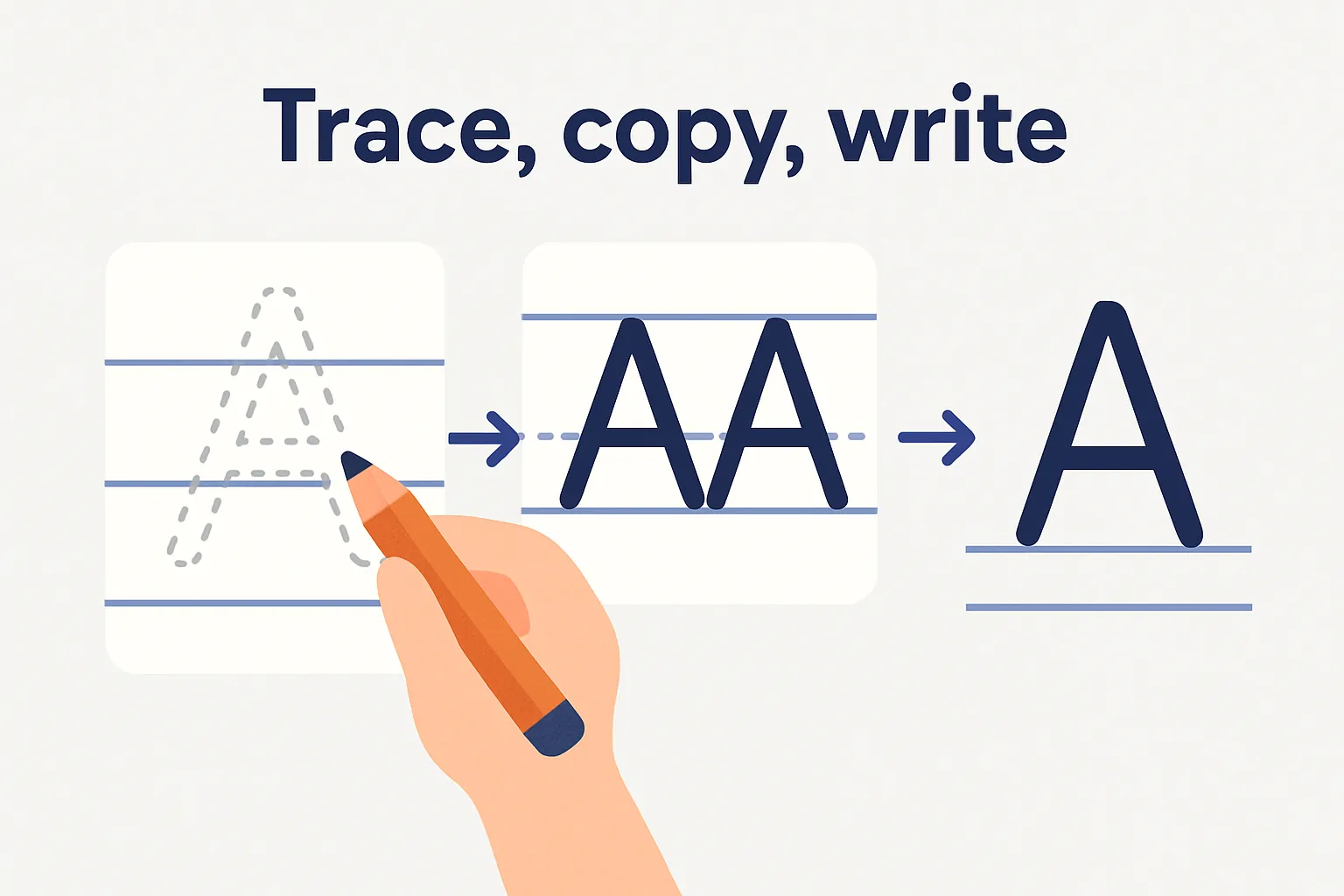
Tracing has a bad reputation in some classrooms and a devoted following in others, so it helps to look at actual evidence. In a study at Indiana University, researchers Karin James and Laura Engelhardt had 5 year olds who could not yet read work with letters in three ways: writing them freehand, tracing them, or typing them. Afterward, the children looked at letters while in a brain scanner. Only the children who had written letters freehand showed activity in the brain's reading circuit. The tracers and the typists did not.
That result does not make tracing useless. It makes tracing a starting point with an expiry date. The full path up has three rungs: trace, copy from a model, write from memory. Each rung trains something the one below it cannot, and handwriting only counts as learned at the top.
Does tracing actually help kids learn to write?
Yes, for beginners, and for one specific job: tracing teaches the route. Every letter is a sequence of strokes with a correct starting point, direction, and order, and a child tracing a well made model feels that route in the hand without having to invent anything. That is real learning, and it is the gentlest on-ramp there is.
Tracing earns its keep in three ways. It builds pencil control on a forgiving track, because the target sits right under the tip. It drills correct stroke order before bad habits can form, which matters later, since a letter built with odd strokes turns slow and messy once a child needs to write quickly. And it lets a child produce a good looking letter on day one, which does more for motivation than any sticker chart.
What tracing cannot do is teach recall. A traced letter comes from the page, not from the child's memory, and real writing runs on memory. The Indiana findings point the same way: producing letters yourself, wobble and all, engaged the reading circuitry in a way that following a printed outline did not. The wobble seems to be part of the point. A child's own variable, imperfect letters teach the brain what a letter really is better than perfect guided copies do.
What is the trace, copy, write from memory ladder?
It is the natural progression from full support to none. First a child traces the letter, following a printed model with the pencil. Then they copy it, looking at a model but forming the letter on their own. Finally they write it from memory, with nothing to look at. Each rung removes one support and trains one new skill.
- Trace: the pencil follows the letter. This trains stroke order, direction, and pencil control. The child borrows the shape from the page.
- Copy: the letter sits above or beside the writing line as a model. This trains building the shape from scratch while checking it against a target. The eyes do the remembering.
- Write from memory: no model at all. This trains recall, the skill actually used in real writing. The child owns the letter now.
Copying is the underrated middle child of the three. It is where most of the visible progress happens, because the child is doing everything real writing requires except the remembering. Give copying at least as much time as tracing, and usually more.
The top rung, free writing, is where the payoff shows. Writing from memory is what school demands: spelling words on a test, a sentence in a journal, a name at the top of the page. It is also the rung the Indiana study speaks to, since the children there generated letters themselves. Recall built at the memory rung is what turns handwriting from an exercise into a tool a child can actually use.
When should my child move from tracing to copying?
Move up as soon as tracing looks easy, and that happens sooner than most parents expect: often within days for any single letter, not weeks. The test is simple. If your child traces a letter smoothly, starts at the right spot without being reminded, and stays close to the lines, that letter is ready for copying.
Promote letter by letter, not the whole alphabet at once. It is completely normal for a child to write o and t from memory while still tracing q and z, and the mix keeps sessions balanced: something easy for confidence, something in progress, something new. Boredom is a promotion signal too. A child sighing through a tracing row has already outgrown it.
For the step from copying to memory, use the cover trick, often taught in schools as look, cover, write, check. Your child studies the model, you cover it with your hand or a card, they write the letter, then you uncover it together and compare. It turns copying into recall one attempt at a time, and most kids treat it as a game rather than a test.
A trace then copy worksheet does most of this scheduling for you. Each row of the printable handwriting practice sheets starts with traceable letters and ends with a blank line, so the ladder is built into the page. The free name tracing generator does the same thing with your child's own name, which is the word they will happily climb the ladder with first.
What happens if a child only ever traces?
They plateau, and the plateau is sneaky because the work still looks great. Traced pages come out neat, everyone feels productive, and meanwhile the child may be learning very little, since a hand can follow a line while the mind wanders somewhere else entirely. Teachers know the pattern well: a folder full of beautiful traced pages, and a child who freezes in front of blank paper.
There is a quick test for whether tracing is still earning its place. At the end of a session, ask your child to write one of the letters they just traced on a plain piece of paper. If a recognizable letter comes out, the tracing is feeding real learning. If they freeze or produce something unrelated, the practice has gone hollow and it is time to move up a rung.
Staying on tracing too long is probably the most common mistake in home handwriting practice, and it usually comes from kindness. Tracing is calm, tidy, and tear free, while copying is messier, so families settle where the frustration is lowest. But the mild struggle of the next rung is the feeling of the actual skill being built. A bit of wobble and effort is evidence of progress, not a reason to retreat.
How to fade the supports
- Full trace: light gray or dotted letters that the pencil follows completely.
- Partial trace: a starting dot and a faint outline, so the child supplies more of the shape.
- Copy: one model letter at the start of the row, blank line after it.
- Memory: blank line only. Bring the model back briefly whenever a letter falls apart.
Slide one step forward whenever the current step feels comfortable, and slide one step back, never all the way down, when a letter degrades. The ladder runs in both directions, and no rung is a failure. Dropping back to copy a letter that got sloppy is exactly how the ladder is meant to be used.
How do I combine tracing, copying, and memory writing in one session?
Use all three in one short session, weighted toward wherever your child currently is. A true beginner might trace for most of it and attempt a single copy. A kindergartner might trace one new letter, copy two familiar ones, and finish by writing their name from memory. Five to ten minutes covers all of it.
- One minute: trace the newest letter a few times, big and slow.
- A few minutes: copy recently learned letters, one row each, with the model at the start of the row.
- One or two minutes: the memory round. Cover everything and write the oldest, most familiar letters, or their name.
- Last minute: your child circles their best letter of the day.
A mix like that touches every rung in every session, so old letters do not rust while new ones move up. If sessions run long or turn sour, cut length before you cut the memory round. Our guide on how long handwriting practice should be explains why five good minutes beat twenty grudging ones, and the multisensory activities guide adds ways to practice the same shapes away from paper.
Make a name tracing worksheet
Type a name, pick a font, and print a free tracing sheet to practise with.