Handwriting goals for kids: measurable examples by grade
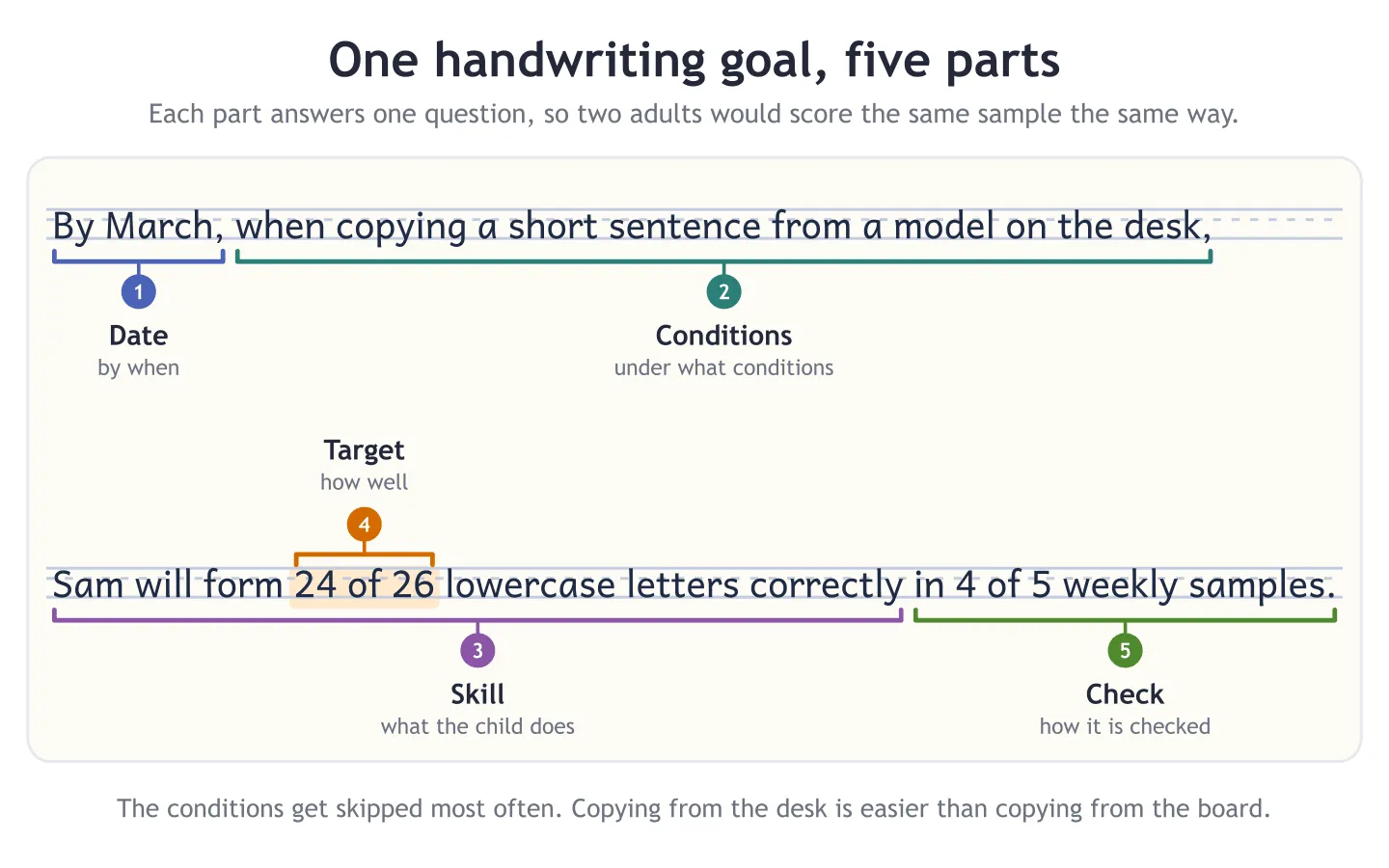
A good handwriting goal names one skill, one number to hit, and how you'll check it. For example: by March, when copying a short sentence from a model on the desk, Sam will form 24 of 26 lowercase letters correctly in 4 of 5 weekly samples. Pick the skill that hurts readability most right now, set the target a step past today's work, and plan on at least 20 practice sessions to get there.
That number, 20 sessions, comes from research. In 2011 Hoy, Egan and Feder pooled the controlled trials of handwriting help for school-age children who struggled to write, in a review for the Canadian Journal of Occupational Therapy. Eleven studies made the cut. Whatever the method, programs without real handwriting practice didn't work. Neither did programs with fewer than 20 practice sessions.
So a goal on its own changes nothing. It's a target for practice, and a way to tell whether the practice is working.
What is a handwriting goal?
A handwriting goal is a short written target for one part of a child's writing, such as letter formation, size, spacing or speed, with a number attached and a date to reach it. Teachers and occupational therapists write them into IEPs. Parents can use the same format at home, with no paperwork, to keep practice aimed at one thing.
In the US, an IEP has to contain them. The federal special education rules (34 CFR 300.320) require measurable annual goals, a description of how progress on each one will be measured, and regular progress reports to parents, for example every quarter with the report card. The word doing the work is measurable. "Will improve handwriting" isn't a goal, because nobody can say in March whether it happened.
How do you write a measurable handwriting goal?
Give it five parts: a date, the conditions, a skill you can see on the page, a target number, and the way it gets checked. Written out, it reads: by (date), when (conditions), (child) will (skill) with (target), measured by (method). If two adults would score the same sample differently, tighten the skill or the number.
The conditions get skipped most often, and they change everything. Copying from a model on the desk is easier than copying from the board, and both are easier than writing from memory or making up a sentence. For the date, the next report card works for school, and 8 to 12 weeks works for home. For the check, a weekly dated sample scored against a short checklist is plenty.
Here's a vague goal tightened up. "Lily will write neatly" becomes: by the end of term, when copying a 3 sentence passage in 5 minutes, Lily will write so that 9 of 10 words can be read by an adult who hasn't seen the passage, across 3 weekly samples.
Leave some room in the target. Adults don't write every letter perfectly either, and a goal that demands 100 percent turns one bad day into a missed goal. That's why 80 percent, or 4 of 5 samples, shows up in so many IEP goals.
Which handwriting skills should a goal target?
The one that makes the page hardest to read right now. For most children that's letter formation, letter size, spacing or speed. Grip and posture matter, but they serve the writing, so tie them to something on the page. Work on one goal at a time, two at most, even for a child with five problems.
How to measure each one:
- Letter formation: have the child write the lowercase alphabet from memory while you watch, and count the letters built with the right strokes, out of 26.
- Size: count the words in a copied sample where tall letters reach the top line, small letters fill the bottom half, and tails drop below.
- Spacing: count the correct gaps between words out of all the gaps.
- Speed: time a 1 to 3 minute copy of a printed passage the child hasn't seen, then divide the words by the minutes.
- Legibility at speed: ask someone who hasn't seen the passage to read the fast copy aloud, and count the words they get right.
Grip goals are common and hard to defend, because two studies comparing the four mature pencil grips found no real gap in speed or legibility (our pencil grip guide has the details). If a grip hurts or slows the child down, measure that instead.
Handwriting goals by grade, with examples
Match the goal to what the grade asks for, then pull it back to where the child is today. The Common Core standards, which most US states adopted in some form, expect kindergartners to print many of the capital and lowercase letters and first graders to print all of them. After that, the work moves to size, spacing and speed. The examples below suit a child who's a little behind.
Preschool and pre-K (ages 3 to 5)
Shapes come before letters. Most children copy a vertical line, a horizontal line and a circle by about 3, then a cross, a square, an X and a triangle between 4 and 5. Example goal: by spring, when shown a drawn model, Leo will copy a cross and a square with lines that meet and corners that close, in 4 of 5 tries.
Kindergarten (ages 5 to 6)
The name is the natural first target, and it's the word a child will write most. Example goal: by the end of the year, Mia will write her first name from memory, a capital followed by lowercase letters, with every letter started at the top, in 4 of 5 tries. For a child further along: Mia will write 20 of 26 lowercase letters correctly when they're read aloud to her in random order.
Grade 1 (ages 6 to 7)
All 26 letters are the standard by June, and spacing between words turns into the big visible problem. Example goal: by the end of the year, when copying two sentences from a model on the desk, Noah will form every lowercase letter correctly and leave a space in 8 of 10 gaps between words, across 3 weekly samples.
Grade 2 (ages 7 to 8)
Size and sitting on the line. Reversals are fading but not gone yet. Example goal: by the end of term, when copying a 3 sentence passage, Ella will keep small letters in the bottom half of the line and tall letters touching the top line in 80 percent of words.
Grade 3 (ages 8 to 9)
Written answers get longer, so stamina and speed start to count. Many schools also begin cursive this year. Example goal: by March, Jack will copy a printed passage at 7 words a minute for 3 minutes, with at least 90 percent of the words readable to an adult who hasn't seen it.
Grades 4 and 5 (ages 9 to 11)
Handwriting now has to keep up with thinking. Common Core also expects a fourth grader to type at least a full page in one sitting, so a typing goal can sit next to a handwriting one rather than replace it. Example goal: by June, when answering a question in writing, Zoe will produce at least 40 readable words in 10 minutes, scored monthly by her teacher.
How fast should a child write at each grade?
On a copying task, about 5 words a minute in grade 1, rising to 10 by grade 5 and 16 by grade 8. Those averages come from studies compiled in 1995 by occupational therapist Susan Amundson for her Evaluation Tool of Children's Handwriting. Montgomery County Public Schools in Maryland prints them as the benchmark table in its assistive technology handout.
Average copying speed by grade:
- Grade 1: about 5 words a minute
- Grade 2: about 6
- Grade 3: about 7
- Grade 4: about 8
- Grade 5: about 10
- Grade 6: about 12
- Grade 7: about 14
- Grade 8: about 16
Use these as a check, not a race. A 1998 study by Steve Graham, Virginia Berninger and two colleagues timed 900 children in grades 1 to 9 who were told to copy as fast as they could without mistakes, and got higher numbers: 10 words a minute in grade 3, 15 in grade 5, 24 in grade 9. The Montgomery County handout treats those as a ceiling.
Composing is slower than copying at any age. In a 1990 study, Graham clocked fourth graders with learning disabilities at 4 to 5 words a minute while writing their own sentences. Set speed targets on copying tasks, not on composition.
How long does it take to reach a handwriting goal?
Plan on about three months of short, regular practice. The 2011 review found that programs under 20 practice sessions didn't work, and a well-known Seattle trial ran 24 tutoring sessions of 20 minutes, about twice a week. That's roughly 12 weeks. Set a home goal 8 to 12 weeks out and check progress every two weeks along the way.
In that trial, Virginia Berninger and Robert Abbott at the University of Washington screened more than 700 first graders and picked 144 who were struggling to write. In every session the children practiced all 26 letters. The group that did best studied each letter with numbered arrows showing the stroke order, then covered it and wrote it from memory. That group beat every other group on letter writing, and on writing their own sentences too.
You can run the same routine at home: trace a few target letters, study one, cover it, write it from memory, then uncover the model and compare. Ten minutes a day is right for a kindergartner, and fifteen is the most a second grader needs.
How to track progress at home
- Take a baseline on three different days: the lowercase alphabet from memory, a 1 minute copy of a short printed passage, and the child's name. Date each sample.
- Score each sample against the goal and nothing else. If the goal is spacing, count gaps and leave the letter shapes alone.
- Repeat the same tasks every two weeks, with the same passage length and the same paper, so the numbers stay comparable.
- Put the scores on a chart the child can see. A line climbing from 12 to 19 correct letters motivates more than any sticker.
- When the target holds for three samples in a row, the goal is met. Pick the next skill.
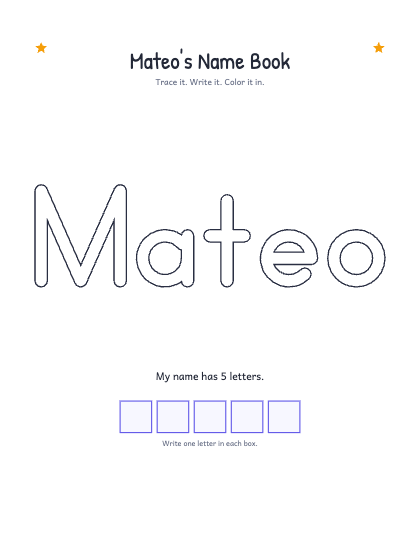
Between checks, practice the exact letters or words in the goal. Type your child's name or the week's target letters into the name tracing generator, choose dotted letters, and print a page to trace before copying. For size goals, three-line paper with a dashed middle line gives small letters a lane to fill.
If 20 sessions have gone by and the numbers haven't moved, or writing hurts, or your child sits well below the copying speed for their grade, ask the school in writing for an evaluation. Bring the dated samples and the chart. They're the evidence an IEP team asks for.
Make a name tracing worksheet
Type a name, pick a font, and print a free tracing sheet to practise with.