How to improve your child's messy handwriting
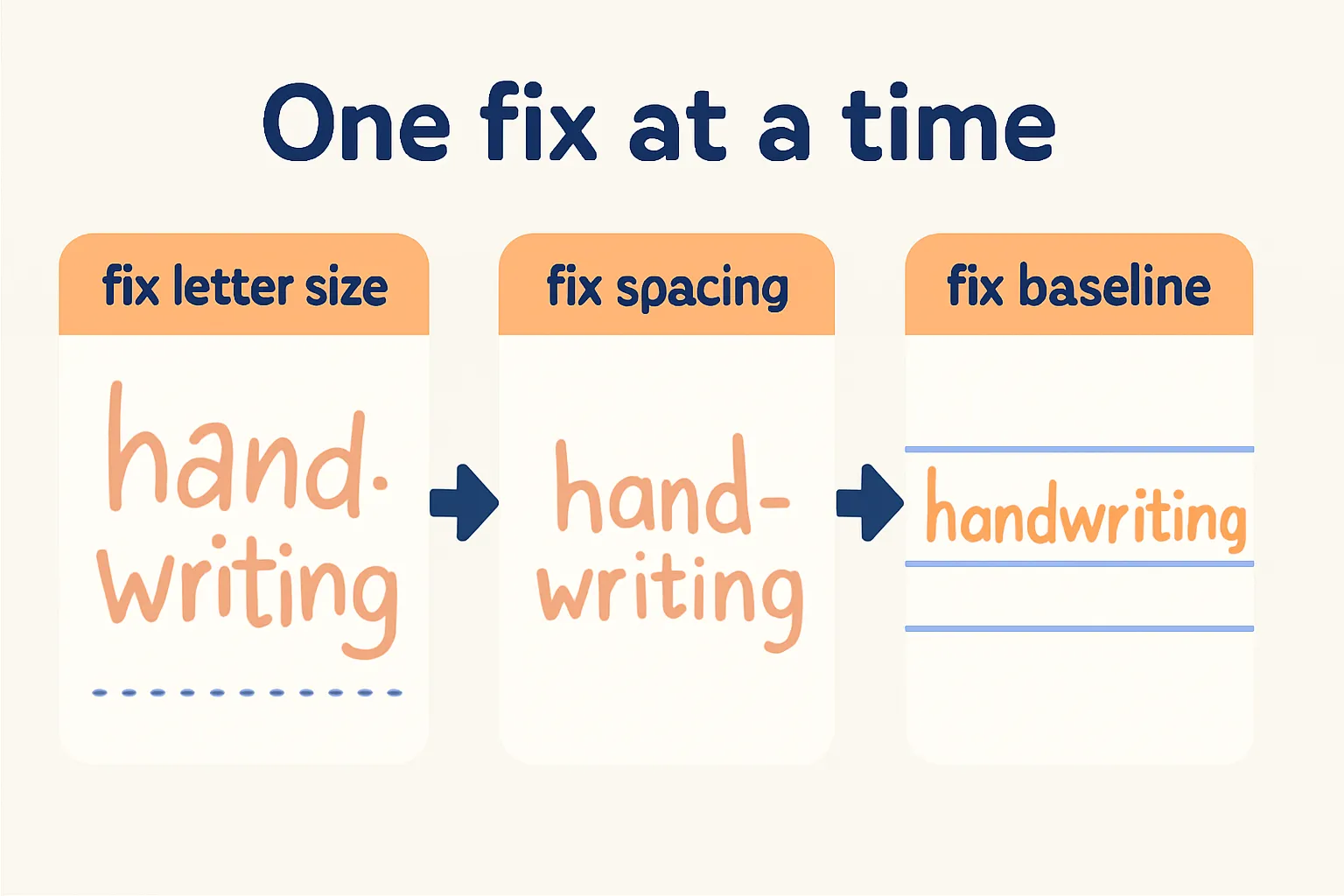
Messy handwriting at 6 to 8 usually comes down to one fixable problem: letter size, spacing, letter formation, speed, or posture and grip. Watch your child write, name the biggest problem, and work on that one thing for a few weeks before touching the next. Some mess is normal at this age, since hand control is still developing.
If you can barely read your child's schoolwork, you are in large company. A study in the NIH library estimates that handwriting difficulties affect between 10 and 30 percent of school-age children, and plenty more kids are simply untidy without any real difficulty behind it. The encouraging part: messy writing at this age is usually a skills gap, not a care gap, and skills can be taught.
The trap most parents fall into is asking for "neater writing" in general. That request is too vague for a child to act on. What works is finding the one thing that makes the writing hard to read, fixing that alone, and leaving the rest for later.
Why is my child's handwriting so messy?
Almost all messy handwriting in 6 to 8 year olds traces back to one of five causes: letter size, spacing, letter formation, speed, or the way the child sits and holds the pencil. A page rarely fails at everything. Usually one problem does most of the damage, which means the writing looks worse than the underlying skill really is.
- Size: letters are too big, too small, or wildly uneven, so words look chaotic even when each letter is formed correctly.
- Spacing: letters crash into each other or words run together, so a reader cannot tell where one word ends and the next begins.
- Formation: letters are built with the wrong strokes, like an "o" drawn clockwise or an "a" started from the bottom. Wrong strokes hold up in slow practice, then fall apart at speed.
- Speed: the child rushes, and letters that look fine when they are careful collapse in real schoolwork.
- Posture and grip: a slumped body, a page that slides around, or a tight fist on the pencil makes every stroke harder to control.
How do I find the real problem?
Watch your child write for two or three minutes and compare what you see against a short checklist. Do not judge from rushed schoolwork. Sit them down at a clear table, ask them to copy two sentences at a normal pace, and watch the hand and body as much as the page.
- Check the body first. Feet on the floor, paper tilted slightly, the non-writing hand holding the page still. If your child is slumped or the paper drifts around, start there before blaming the letters.
- Watch stroke direction on a few letters. Does the "o" go counterclockwise? Does the "t" start at the top? Letters built in the wrong direction point to a formation problem.
- Look at the finished page from across the table and squint. Squinting hides detail and shows the pattern: is the mess mostly uneven size, or mostly crowding?
- Compare careful writing to fast writing. Ask for one sentence at "best writing" pace and one at normal pace. If the careful version is fine, the problem is speed, not skill.
- Have your child read their own writing back the next day. If they cannot, they will usually agree something needs work, which lands far better than you telling them.
How do I fix messy handwriting one thing at a time?
Pick the single biggest problem and work on it for two to three weeks before touching anything else. Ten minutes a day is plenty. Kids improve fastest when the target is narrow enough to hit, like "small letters stay in the bottom half of the line," rather than a broad "write neatly." Name the target out loud at the start of each session so you are both aiming at the same thing.
If the problem is size
Use paper with clear guide lines and teach the three letter heights. Tall letters like l, k, and t touch the top line. Small letters like a, m, and e fill the bottom half. Tail letters like g, y, and p hang below the line. Highlight the bottom half of each writing line with a yellow marker so the small letters have a lane to fill, and practice a few words a day inside it.
If the problem is spacing
Teach finger spaces. After each word, your child lays the index finger of their non-writing hand on the page and starts the next word on the far side of it. A craft stick with a face drawn on it, often called a spaceman, does the same job and feels like a toy. After a few weeks the finger comes off and the habit stays.
If the problem is formation
Go back to tracing, a few letters at a time. Tracing rebuilds the stroke pattern without asking the child to invent the letter, and it feels easy, which matters for a kid who is tired of being corrected. Print rows of the letters that fail most often, talk through where each stroke starts, and trace a row a day before writing the letter freehand.
If the problem is speed
Slow the writing down, then rebuild the pace. Each day, have your child write the same sentence twice, once at best-writing speed and once at normal speed, and date the page. When the normal version starts to look like the careful one, the new habit has taken hold and you can move on.
What is normal handwriting for each grade?
A first grader writes legibly but unevenly, a second grader writes steadier with real word spacing, and a third grader stays fairly consistent even at speed. Reversals fade across this span. None of these stages look "neat" the way adult writing does, and holding a 6-year-old to an adult standard only discourages everyone.
- Grade 1, around age 6 to 7: most letters are recognizable, sizes wobble, some b and d reversals appear, and words sometimes run together. All of this is normal.
- Grade 2, around age 7 to 8: letters sit on the line most of the time, word spacing is mostly there, reversals are fading, and the writing holds up across a short paragraph.
- Grade 3, around age 8 to 9: size and spacing are fairly steady, reversals are rare, and the writing stays readable even when the child works fast.
If your child is roughly inside these bands, the mess you see is the normal cost of a skill still under construction. Keep practice light and let the grades do their work.
When is messy handwriting fine, and when does it need help?
Messy is fine when the writing is readable, the hand does not hurt, and your child keeps up with classwork. It needs attention when writing is painful, much slower than classmates, unreadable even to the child, or stuck at the same level despite weeks of regular practice.
Signs worth acting on:
- Your child complains of a sore or tired hand after a few minutes of writing.
- They avoid writing tasks they used to accept, or melt down over short ones.
- They cannot read their own work back, even the next day.
- The teacher says written work sits far below what your child can say out loud.
- Reversals like b and d are still frequent at the end of third grade.
If several of these ring true, talk to the teacher first and ask whether a screening with an occupational therapist makes sense. Schools see this often and there are good tools for it. For everyday messiness, though, short home practice does the job. Print rows of the troublesome letters from the printable handwriting practice sheets, or build a worksheet from your child's own name with the free name tracing generator, and work your one chosen fix for a few weeks. Then pick the next one.
Make a name tracing worksheet
Type a name, pick a font, and print a free tracing sheet to practise with.