Handwriting practice at home: a realistic weekly schedule
Aim for about ten minutes a day, four or five days a week. Rotate the work: trace one day, copy the next, use real jobs like lists and cards on another, and end the week with a game and some free writing. Short regular sessions beat one long weekend push, and the routine matters more than the minutes.
Practice works, and there is solid evidence for it. A review in the NIH library pooled 31 studies covering just over 2,000 elementary students and found that handwriting instruction clearly improved how quickly and easily children write, compared with kids who got none. The hard part for families was never whether practice helps. It is fitting practice into real life, between school, dinner, and everything else. This plan is built for that.
Everything below works for school families topping up what class provides, and for homeschoolers where home is the classroom. The only difference is that homeschoolers may run the routine five days instead of four.
How often should a child practice handwriting at home?
Four or five short sessions a week, about ten minutes each, suits most 4 to 8 year olds. Daily is fine if it stays light. Regularity matters more than session length, because young hands build habits through frequent repetition, and a forty minute Sunday marathon mostly builds resentment.
Pick a fixed slot and defend it. After breakfast, right after school with a snack, or before a bedtime story all work. A predictable time removes the daily negotiation, which is where most home practice plans quietly die. If your child is having a rough day, shrink the session to five minutes rather than skipping it. The habit survives a short session. It rarely survives a string of skipped ones.
Adjust for age. A 4 or 5 year old may only manage five focused minutes, and that is fine, since the routine matters more than the clock. A 7 or 8 year old can stretch to twelve or fifteen minutes on a good day. Follow the child, and treat ten minutes as a ceiling to protect, not a quota to fill.
What does a good ten minute handwriting session look like?
A good session has three parts: a two minute warm-up, six minutes of focused work on one target, and two minutes of something fun to finish. One target per session, named out loud at the start, like "today we keep our words apart" or "tall letters touch the top line."
- Minutes 1 to 2: warm up. A few hand squeezes and finger push-ups, then a row of loops or zigzags on scrap paper to get the pencil gliding.
- Minutes 3 to 8: the main work. Trace or copy a few rows aimed at the day's target. Sit beside your child for the first row, then let them run the rest. Stop at six minutes even if a row is unfinished.
- Minutes 9 to 10: the fun finish. A silly sentence, a joke to copy out, a picture to draw and label, or a secret word they write for you to guess.
Always stop while it is still going well. A session that ends with a laugh gets repeated tomorrow. A session that ends in a battle over one more row does not.
What should a weekly handwriting schedule include?
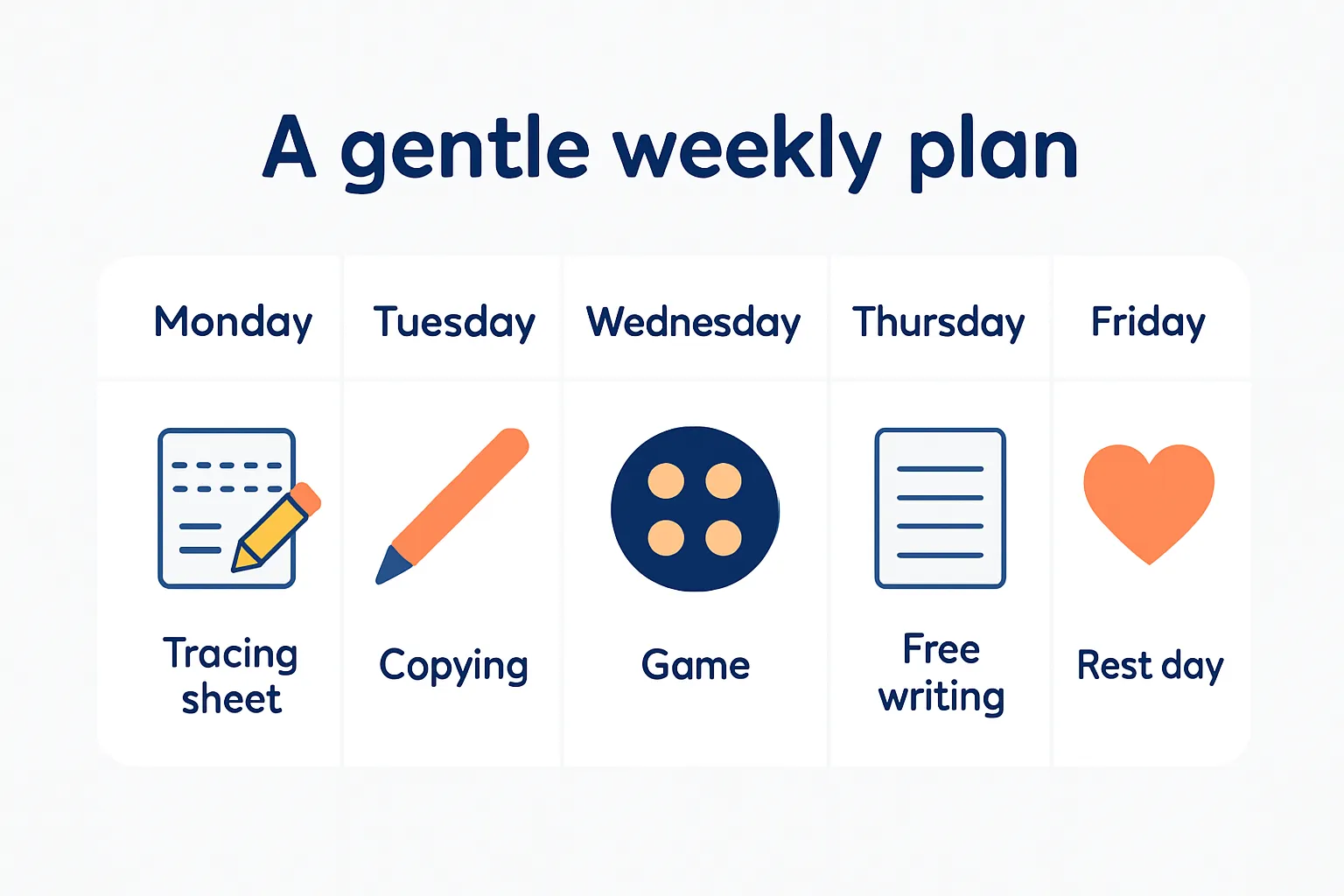
A good week mixes four kinds of practice: tracing, copying, everyday writing, and play. Tracing builds letter shapes, copying builds independence, everyday writing makes the skill useful, and games keep the whole thing from feeling like extra homework. Here is a week that busy families can actually run:
- Monday: tracing. Rows of the letters or words your child finds hardest, traced first, then written once without the guide.
- Tuesday: copying. Two or three short sentences copied from your model, with one clear target like spacing or letter size.
- Wednesday: everyday writing. The shopping list, a label for a drawer, a note for the lunchbox. Real jobs, real pencil.
- Thursday: a game. Hangman, a treasure hunt clue they write for you to follow, or letters drawn on a foggy mirror.
- Friday: free writing. Two sentences about anything they choose, with no corrections unless they ask for them.
- Weekend: off, unless your child asks to write. Rest is part of the plan, and asking is a great sign.
Swap the days around freely. The order matters much less than covering all four kinds across the week. If a day collapses into chaos, drop it without guilt and carry on. A four day week that actually happens beats a perfect week that exists only on the fridge.
A homeschool variation
Homeschoolers can run the same rotation five days a week and attach it to another subject, since copying works with any material. A science fact on Tuesday, a line from a poem on Friday. If handwriting is your main writing instruction rather than a top-up, keep sessions at ten minutes anyway, and add a second short burst later in the day instead of one long block. Two spaced sessions beat one double-length one, because the hand gets a second fresh start.
How can everyday writing count as practice?
Any writing with a real purpose counts, and kids often try harder on it than on worksheets, because a real person will read the result. Keep each job short, somewhere between five words and a couple of sentences, and hand your child full ownership of it, wobbles and all.
- Birthday cards and thank-you notes, even if you write most of it and they sign and add one line.
- The family shopping list, with you dictating and your child writing.
- Name labels for school gear, folders, and a sign for the bedroom door.
- A short weekly note to a grandparent or cousin. Getting a reply in the mail is the strongest writing motivator there is.
- Menus, tickets, and shop signs for pretend play, which is handwriting practice wearing a costume.
On busy weeks, everyday writing can carry the whole plan. A list on Tuesday, a card on Thursday, and a door sign on Saturday add up to more pencil time than many kids get from worksheets, with none of the arguing.
How do I track progress without adding pressure?
Keep dated samples and compare them monthly, not daily. Once a month, have your child write the same two sentences, date the page, and put it in a folder. Day-to-day writing wobbles with mood and tiredness, so daily comparison discourages everyone. A month apart, the improvement is usually plain enough that your child spots it themselves.
- Praise the specific thing you practiced, like "your words have real spaces now," rather than a general "so neat."
- Let your child circle their own best word or line on each page. Self-spotting quality builds a better eye than being told.
- Never compare with a sibling's writing, in either direction. It sours practice for both of them.
- If a whole week falls apart, restart on Monday without a post-mortem. Missed sessions are normal. Quitting over them is the real risk.
For the tracing and copying days, the printable handwriting practice sheets cover the alphabet in a trace-then-write layout, and the free name tracing generator turns any word, including your child's own name, into a worksheet. Print a small stack on Sunday evening and the week mostly runs itself.
Make a name tracing worksheet
Type a name, pick a font, and print a free tracing sheet to practise with.