Handwriting warm up exercises that take two minutes
Give the hands two or three minutes of work before your child writes. Off the paper, use finger squeezes, spider push-ups, and pencil walks to wake up the small muscles. On the paper, warm up with rainbow tracing, rows of loops, and zigzag lines. Warmed-up hands write with more control from the very first letter.
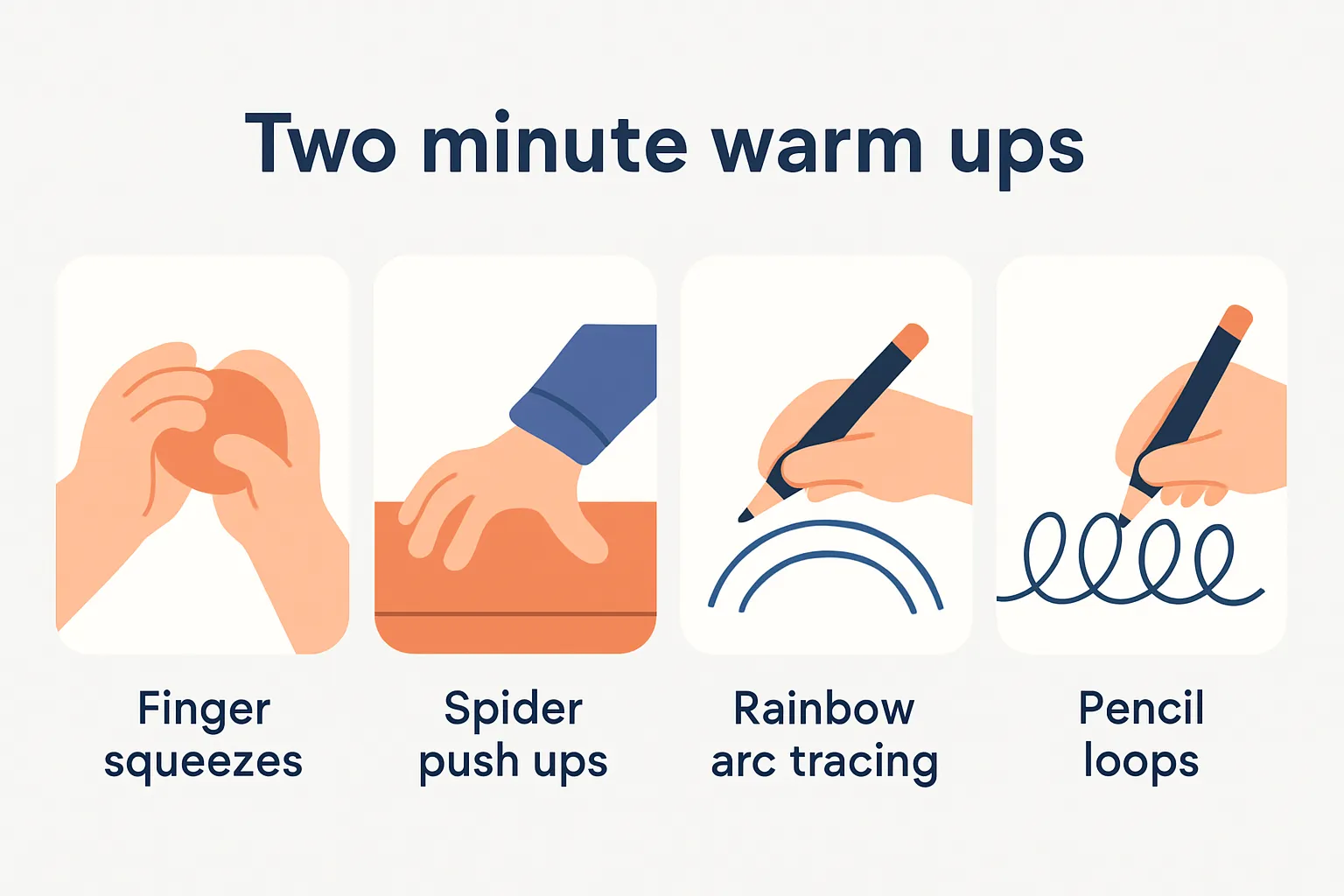
Occupational therapists, the specialists schools bring in when writing is a struggle, treat warm-ups as standard practice. The OT Toolbox, a resource site run by occupational therapists, notes that many children complain of tired hands when they write, and that the body's position sense often needs waking up before a precision task like handwriting. Two minutes of preparation deals with both, and it costs nothing.
Below are the hand exercises, the on-paper warm-ups, and a quick routine for each age. Pick a couple from each list. You do not need all of them, and you never need more than three minutes.
Why do warm ups improve handwriting?
Writing asks small, easily tired hand muscles to make precise movements for minutes at a time, and cold, stiff fingers do that badly. A short warm-up gets blood moving, loosens the fingers, and reminds the hand where it is in space, so the pencil obeys from the first stroke instead of the tenth.
There is a second benefit that has nothing to do with muscles. A warm-up marks a clean start. Kids switch from playing to practicing badly when the change is abrupt, and a familiar two minute routine acts as the doorway. By the time the shakes and squeezes are done, the wiggles have somewhere to go and the child is sitting, focused, with a pencil in reach.
You can see the effect on the page. Without a warm-up, the first line of a practice session is often the worst one, full of wobble that fades as the hand loosens. Warming up moves that wobble onto scrap paper, where it costs nothing, so the worksheet starts at the hand's real level.
What hand and finger exercises make good warm ups?
Squeezes, spider push-ups, and pencil walks are the core three. Pick two or three moves, spend ten to twenty seconds on each, and keep the whole set to about a minute. Nothing here needs equipment beyond a pencil and maybe a lump of play dough, and kids learn the moves in a day or two.
- Spider push-ups: press the fingertips of both hands together with the palms apart, then push the palms toward each other and apart again ten times, like a spider doing push-ups on a mirror.
- Pencil walks: hold the pencil in writing position, then "walk" the fingers from the tip up to the eraser and back down without help from the other hand.
- Squeezes: squeeze a stress ball, a lump of play dough, or a rolled-up sock as hard as possible for five seconds, release, and repeat five times.
- Finger taps: tap the thumb to each fingertip in order, then in reverse, then again faster. Do both hands, since the helper hand holds the paper.
- Wake-up shakes: shake both hands loosely for ten seconds, like shaking off water. A good opener and a good reset if the hand tires mid-session.
If your child finds these moves hard, that is useful information, not a failure. Weak little hand muscles are one of the most common reasons young writers press too lightly, tire quickly, or grip the pencil in a fist. A few weeks of daily squeezes and spider push-ups builds exactly the strength writing draws on.
Make the set playful and it will stick. Count the spider push-ups in a silly voice, race the finger taps against a ten second timer, or let your child pick the order each day from the "menu" of moves. The exercises work the same either way, but a child who thinks of them as a game will do them without being asked, and that consistency is where the benefit comes from.
What are good on-paper warm ups?
Big, flowing strokes with no letters involved. Rainbow tracing, loop rows, and zigzags get the pencil gliding and the wrist moving before your child has to think about letter shapes. One or two rows on scrap paper is enough, and because there are no letters, there is no way to get it wrong.
- Rainbow tracing: draw one large arc and have your child trace over it five or six times in different colors until it becomes a rainbow. Big arm movement, light pencil pressure, and it doubles as the prettiest warm-up on the list.
- Loop rows: a line of connected loops across the page, like a row of cursive letter e shapes. Then a second row with the loops turning the other way.
- Zigzag rows: sharp up-and-down zigzags across the page, followed by a row of gentle waves. Switching between sharp corners and smooth curves is exactly the control letters demand.
- Big-to-small circles: three large circles, then three medium, then three small, keeping them as round as possible as they shrink. Shrinking a shape while keeping its form is the heart of fitting letters between lines.
Keep the warm-up sheet separate from the practice sheet. Scrap paper, the back of old homework, or a small whiteboard all signal that this part is loose and free, and the neat work starts afterward. Watch the pencil pressure during these rows too. If the zigzags carve grooves into the paper, ask for "whisper lines" for a row, then normal ones, so your child feels the difference between pressing hard and gliding before the letters begin.
What warm up routine fits each age?
Keep it near two minutes at every age, and shift the content as your child grows. Four and five year olds need big movements and squishy things. Six and seven year olds handle the classic finger moves plus a paper row. From eight, the routine gets quicker and finer, and kids can run it alone.
Ages 4 to 5
Wake-up shakes, then ten play dough squeezes or pinches, then rainbow tracing with a chunky crayon. Skip pencil walks at this age, since they are too fiddly for most preschool fingers. Keep everything playful. At this age the warm-up may honestly be the most valuable part of the session.
Ages 6 to 7
Spider push-ups, finger taps, and five squeezes, then one loop row and one zigzag row on scrap paper. This is the classic pre-practice routine, and it slots straight into the first two minutes of a ten minute session. Same order every day, so it runs on autopilot.
Ages 8 and up
Pencil walks, fast finger taps in both directions, then big-to-small circles on scrap paper. Older kids can run the whole thing themselves. Write the three moves on an index card, tape it to the desk, and the routine becomes an automatic habit before homework as well as practice.
Then move straight into the writing while the hands are warm. A warm-up followed by a snack break wastes the effect. Keep the practice sheet printed and waiting: grab the printable handwriting practice sheets for letter rows, or make a worksheet from your child's own name with the free name tracing generator, so the pencil goes from the last zigzag to the first letter without a gap.
Make a name tracing worksheet
Type a name, pick a font, and print a free tracing sheet to practise with.