21 hard words to write in cursive
The hardest words to write in cursive are the ones that repeat a stroke or ask the hand to change direction at the wrong moment. Written in cursive, minimum is fifteen nearly identical short strokes in a row. Four lowercase letters cause most of the rest of the trouble: b, o, v, and w end at the middle line instead of the baseline, so the next letter has to be reached across a small bridge. Once you can name the reason a word is hard, the practice gets a lot shorter.
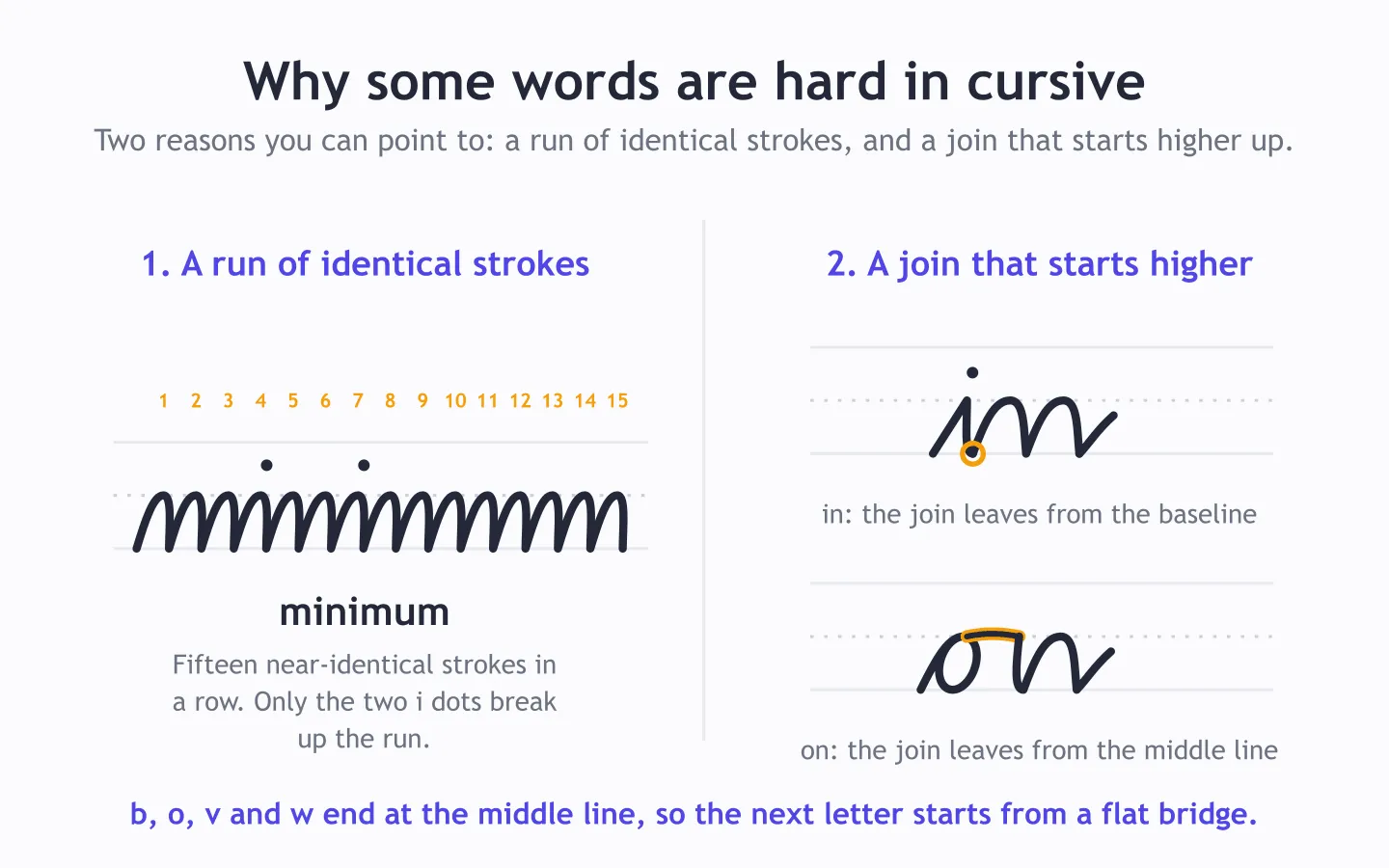
The hard words to write in cursive aren't the long ones. They're the ones that repeat a stroke, or make the hand change direction in the middle of a join. Write "minimum" in cursive and you get fifteen nearly identical short strokes in a row, with almost nothing to tell one from the next. Medieval scribes hit the same wall and named it: minim confusion. Their fix, the little dot on the i, is still sitting on your child's practice page today.
That is the useful part of this list. Every word below is hard for a reason you can point to, and a reason you can point to is a reason you can practice.
What makes a word hard to write in cursive?
Four things, mostly. Runs of identical humps (m, n, i, u). Joins that leave from the middle line instead of the baseline (b, o, v, w). Letters that need a retrace or a cross stroke added afterward (f, t, x, z). And stacked tails that crowd the space under the line (g, j, p, q, y). The words kids dread are usually two or three of these at once.
Runs of identical humps
In cursive, m, n, i and u are built from the same short downstroke. Paleographers call that stroke a minim, and a long run of them is genuinely ambiguous, not a kid problem. The letter group "ium" can be read as uim, mui, niui and several other ways, and only the sense of the sentence sorts it out. Scribes invented two workarounds that English still uses. One was the tittle, the dot over the i, added purely to break up the picket fence. The other was swapping an o in for a u next to m and n, which is why we write come, son and love with an o instead of the u the sound suggests.
So when a child counts humps under their breath and still comes up short, they're wrestling with a thousand-year-old design flaw.
Joins that start from the middle line
Most lowercase cursive letters finish at the baseline and hand off with a clean upstroke. Four don't. The letters b, o, v and w finish up at the middle line, so their exit has to cross to the next letter as a small, nearly flat bridge. Pediatric occupational therapist Colleen Beck calls these the tow rope letters, and she points out that the hand has to switch to a different set of muscles mid-join to make them work.
Four out of 26 letters is not many. But b, o, v and w are common, and they land in the middle of ordinary words all day long.
Retraces and cross strokes
Some letters ask the pencil to go back over a line it already drew, or to lift and add a stroke after the word is done. Lowercase f is the worst of them, and most handwriting teachers name it the single hardest letter in the alphabet. It is the one lowercase letter with a loop above the line and a loop below it, joined by a stem the pencil has to retrace on the way up. The usual result is one loop twice the size of the other.
Cross strokes cause a quieter problem. If a child crosses each t and x as they reach it, the word stops flowing and the join breaks. Cursive works better when the crossing and dotting all happen at the end, which is a habit, not a skill.
Crowded tails
The letters g, j, p, q and y hang below the baseline. One tail is fine. Three or four in one short word means the tails start colliding with each other, and on three-line paper they run into the line below. Kids fix this by making the tails tiny, which makes the letters unreadable, and then the word looks messy for a reason nobody can name.
The 21 hard words to write in cursive
Grouped by what makes each one hard, so you can pick the ones your child actually needs.
Words with a run of identical humps
- minimum. Fifteen minim strokes in a row and no landmark anywhere. The classic.
- unanimous. A picket fence at the front, then a run of humps at the back.
- aluminum. Same problem, with an l near the front to throw off your count.
- immune. Ten humps packed into four letters (m, m, u, n).
- mimic. Two m shapes and two i dots in five letters, so it lives or dies on the dots.
Words full of tow rope joins
- bowl. A b into an o, two middle-line exits back to back, right at the start.
- wobble. Opens on a w, then an o, then a double b. Almost every join is a bridge.
- vowel. The v to o join is the one kids collapse into a single blob.
- overview. Three middle-line exits in one word (o, v, v) plus a w on the end.
- brown. The b to r join is a bridge into a shoulder, which is a direction change and a height change at once.
Words with retraces and cross strokes
- fluffy. Three f loops and a y tail. Ask a fourth grader; they will have opinions.
- difficult. A double f in the middle, then a t to cross and an l to keep tall.
- zigzag. Two z shapes and two g tails, all four dipping under the line.
- affix. Double f, then an x that needs its cross added at the end.
- taxi. Short, but both the t and the x wait for a stroke after the word is finished.
Words with crowded tails
- piggyback. Four tails under the baseline (p, g, g, y) in nine letters.
- jigsaw. A j and a g inside the first three letters, and the j wants a dot as well as a tail.
- quickly. A q tail at the start and a y tail at the end, with a k to keep tall in between.
The all at once words
- rhythm. An r shoulder into an h loop, a y tail, then a crossed t, with no round vowel anywhere to give the hand a rest.
- squirrel. A q tail, then a u, then a double r. The two r shoulders in a row are the part that goes wrong.
- Mississippi. A capital M, two double s pairs, a double p, and four i dots to place. Kids either love it or refuse it.
What is the hardest letter to write in cursive?
Lowercase f, for most children. It is the only lowercase letter with a loop above the baseline and a loop below it, and the pencil has to retrace the stem on the way up before the loop can close. Aim for the two loops being roughly the same size and the letter usually sorts itself out.
The capitals are a separate headache. F, G, Q and Z look nothing like their printed versions, so a child can't reason their way to the shape from what they already know. Cursive capital Q has the best story of the bunch. Until 1996 the Zaner-Bloser capital Q looked like a curly number 2, and the company redrew it as an oval with a tail after the US Postal Service complained: their automated mail scanners kept reading handwritten Q as 2. Richard Northup, then Zaner-Bloser's marketing vice president, told the Baltimore Sun the change came "after the post office got on us."
That history matters at your kitchen table for one small reason. D'Nealian, the other big US handwriting program, still draws its capital Q like a 2. If your child's Q looks wrong to you, check which program the school uses before you correct it. You may be teaching a shape that was retired the year you left school.
How do you practice a hard cursive word?
Practice the join, not the word. Pull out the two or three letters that go wrong, write that cluster on its own line eight or ten times, then put it back in the word. Beck recommends the same thing, working in groups of two to three letters so the hand learns the flow rather than the shape.
A routine that works:
- Write the word once, normally, and circle the exact spot where it fell apart. Usually it is one join, not the whole word.
- Copy out only that pair. For squirrel that is "rr". For bowl it is "bo". Ten of them, big, on wide three-line paper.
- Say the stroke out loud while writing it. Up, over, down. Talking slows the hand to the speed the hand can handle.
- For hump words, count aloud as you go. Three for the m, one for the i, two for the n. Counting is the only thing that reliably beats minim confusion.
- Dot and cross everything at the end, after the last letter, never mid word.
- Write the whole word twice more, then stop.
Two words per session is plenty. Our guide on how long handwriting practice should be makes the case for short and daily over long and occasional, and cursive is where that matters most, because tired hands produce exactly the sloppy joins you are trying to fix. If the letters themselves are still shaky, work on those first; the guide on letter formation order covers which shapes to teach in which sequence.
One thing worth saying to a discouraged eight-year-old: these words are hard for adults too. Nobody writes a fluent "Mississippi" the first week.
The short version
Hard cursive words stack identical humps, middle-line joins, retraced loops, or tails. Minimum, rhythm, squirrel and Mississippi are the ones kids name most, and each is hard in a different way. Find the join that breaks, drill the pair for five minutes, and put the word back together. Then print a fresh sheet and let them try Mississippi again.
Make a name tracing worksheet
Type a name, pick a font, and print a free tracing sheet to practise with.