Pen vs pencil for kids: when to switch and what to buy
Pencil first, and for longer than most parents expect. A child is ready for pen when three things are true: the letters join (or sit consistently, if the school teaches print), tall and small letters keep the right size next to each other, and every word sits on the line. That usually lands around age 8 or 9, but it's a skills check, not a birthday. Until then, a standard HB or 2B pencil is the right tool, in whatever width the child likes to hold.
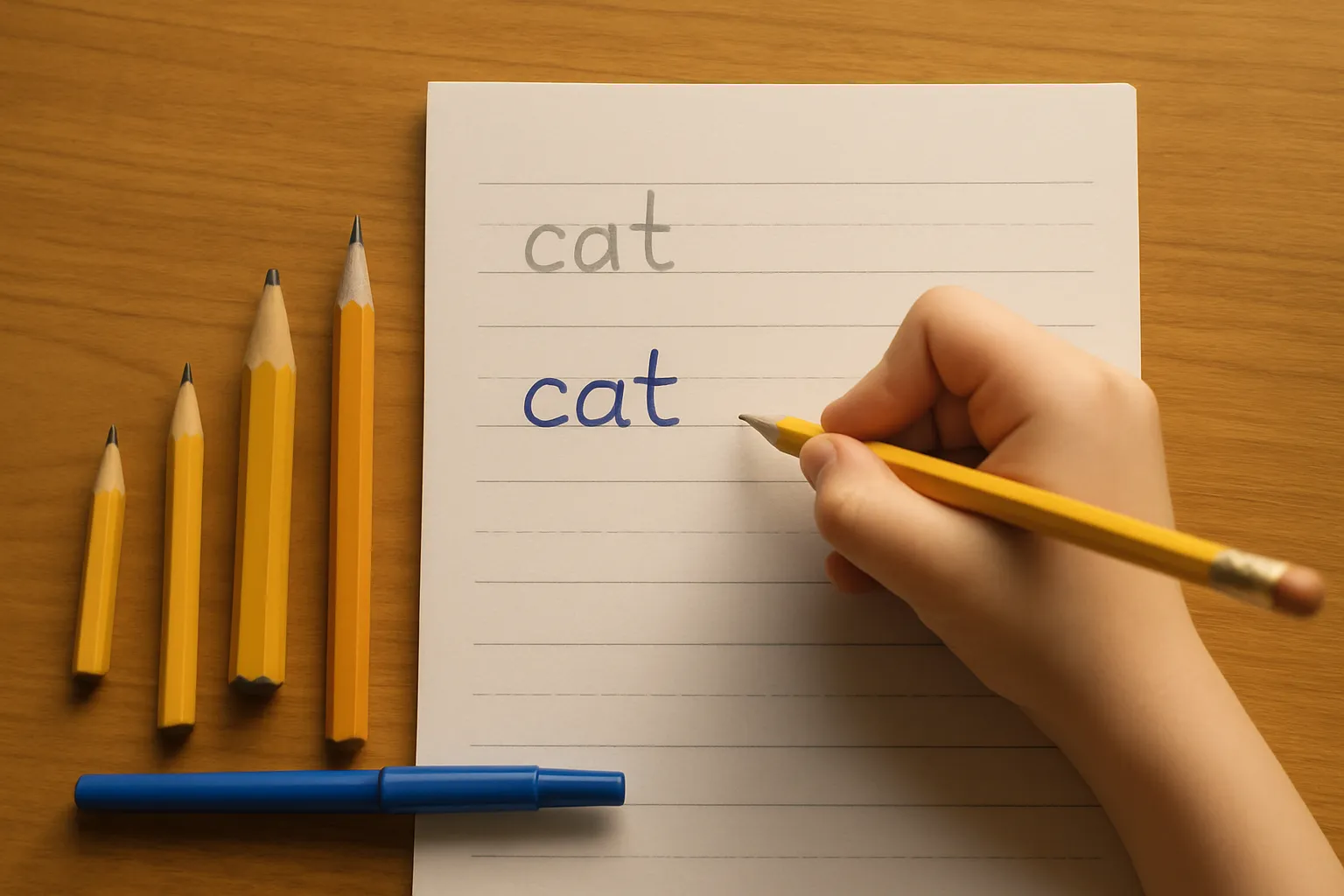
The biggest pencil question has been tested, and it was tested by teachers. Becky Sinclair and Susan Szabo of Texas A&M University-Commerce published a two-week classroom study in 2015 in which 49 children aged 3 to 5 copied the word CAT with four different pencils: a short golf pencil, a short fat one, a standard pencil and a long jumbo. Pencil size made no difference to how legible the writing was. The pressure and the letter shapes came from where the child held the pencil.
The children had opinions, though. The 3 and 4 year olds picked the golf pencil as their favorite, 38 times out of 66. The 5 year olds went the other way and picked the long jumbo, 18 times out of 32. So buy whatever your child will hold happily, and spend your attention on the grip and the pressure instead.
Why do kids start with a pencil?
Because a pencil forgives. It erases, it costs pennies, and it drags on the paper, which gives a beginner's hand more feedback than a slick ink ball does. A pencil line also shows pressure at a glance. Pale and wispy means a high, loose grip. Dark and dented means the child is pressing too hard. That makes a pencil a diagnostic tool as much as a writing one.
Sinclair and Szabo saw exactly that in their classrooms. Children who held the pencil high up the barrel, mostly the younger ones, produced shaky, light writing. Children with a low grip near the point wrote firm, dark letters. With a pen you lose most of that signal, because ink comes out at one darkness no matter how hard the hand works.
Then there's the erasing. A 5 year old writing their name reverses a letter on most attempts, and the point of practice is to fix it and go again. The name tracing generator on this site prints a child's name as traceable letters for that reason: trace, rub out, trace again.
When should a child switch from pencil to pen?
When the handwriting is ready, not when the child turns a certain age. Three checks: the letters join, or sit consistently if the school teaches print; tall letters, small letters and letters with tails keep the same relative size along a line; and every word sits on the baseline. In UK schools this tends to arrive in Year 3 or Year 4, so ages 7 to 9.
England's national curriculum never names an age for pen. It asks Year 2 children to start the strokes that join letters, Years 3 and 4 to join and write fast enough to keep pace with what they want to say, and only in Years 5 and 6 does it list choosing the writing implement best suited to a task. Read that as a window. Children move to pen anywhere between 7 and 11, and the curriculum is fine with all of it.
Many UK primary schools run a pen licence, a certificate that lets a child use pen once a teacher has signed off the checks above, usually in Year 3 or 4. It works as a carrot for some children. The Pen Company's write-up of the scheme lists the other side: the last children to get one feel it, and a child with dyspraxia can wait a year longer than their friends for reasons that have nothing to do with effort. The teacher behind the Teach Handwriting blog adds a classroom rule: judge ability rather than age, and don't hold a child on pencil waiting for perfect writing, because for plenty of kids perfect never arrives.
If your child's school runs the licence, treat it as the timetable and use the three checks at home to see how close you are. If it doesn't, run the checks yourself and switch when all three pass for two weeks running.
Which pencil is best for a child learning to write?
A standard wooden pencil in HB or 2B, kept sharp, in whatever barrel width the child prefers. The grade matters more than the size. Softer graphite lays down a dark line with little force, so a 2B rewards a light hand, while a hard pencil pushes a child to press. Size and shape, on the evidence, change comfort and not legibility.
Pencil grades run from 9H, the hardest and palest, through HB in the middle to 9B, the softest and blackest. There is no industry standard for how dark any grade writes, so an HB from one brand can match a B from another. For a young child, B or 2B is a good default: dark enough to see, soft enough not to need pressure, and it erases cleanly. It blunts faster, so keep a sharpener on the table.
Jumbo pencils are sold on the idea that a fat barrel encourages a proper tripod grip. Carlson and Cunningham argued that in 1990. Oehler's team studied kindergartners in 2000 and found no difference. Sinclair and Szabo's 49 children wrote as legibly with a 0.75 cm barrel as with a 1 cm one. What a jumbo does give you is a thicker core. A Stabilo EASYgraph carries a 3.15 mm lead against about 2 mm in a standard pencil, and a thick lead survives a heavy-handed 4 year old. Buy a jumbo for durability if you like. Don't expect it to fix a grip. Our pencil grip guide covers what does.
Triangular barrels are popular in classrooms, and children who like them should keep them. One caution comes from adult research: Goonetilleke, Hoffmann and Luximon tested nine pen shapes with 27 adults for a 2009 paper in Applied Ergonomics and found comfort and writing ratings fell as the barrel got sharper-edged, with triangular and square grips rated worst. Most children's triangular pencils have rounded edges, so hold one before buying a dozen.
Mechanical pencils come later. A 0.5 mm lead snaps under a beginner's pressure, which is a useful trick for a heavy presser (our pencil pressure guide explains it) but a poor everyday tool at 5 or 6.
Which pen is best for a child?
A fiber-tip or a rollerball, not a cheap ballpoint. Ballpoints need the most pressure of any pen to leave a line, and a child fresh off pencil will press even harder to get one. Fiber-tips (felt tips with a fine point) need the least. Rollerballs and gel pens sit in between and flow without force.
The pressure ranking comes from the same Applied Ergonomics paper: writing pressure ran highest with ballpoints and lowest with felt-tips. The Teach Handwriting blog reports the same from lessons, where cheap ballpoints demand extra pressure and give an uneven line, while fiber-tips and rollers write like a good fountain pen without the mess. A handwriting pen from a school supplier is a fiber-tip with a fine point, and it's the safe first buy.
Fountain pens are a tradition in some schools, and a good one writes with almost no pressure at all. A cheap one scratches, skips and blots, and a scratchy pen teaches pressing all over again. If the school requires one, spend a little more and let the child try it in the shop.
Left-handed children have one extra problem: the hand follows the pen straight across the wet ink. Fast-drying fiber-tip or gel ink beats a slow rollerball for them, and the paper angle matters more than the pen does. Our left-handed handwriting tips cover the angle.
Does a pen or a pencil make handwriting neater?
Neither, on its own. We could not find a study showing children write more legibly with one tool than the other, and the Texas pencil study found the tool made no difference to legibility even across four sizes. Neatness comes from letter formation, size and spacing, and those get taught. The tool changes pressure, feedback and how easy a mistake is to fix.
That's why an early switch goes wrong. On pencil, a heavy hand gets dark, dented paper and a visible warning. On pen, the same hand cramps in ten minutes, the letters shrink, and the child's first fix is to press harder still. If handwriting falls apart after the switch, go back to pencil for a month and try again. Nobody loses anything by waiting.
How to make the switch at home
- Run the three checks on a page of the child's normal work: joins (or consistent print), relative letter size, and words on the line. All three, for two weeks.
- Buy three pens, not one: a fiber-tip handwriting pen, a rollerball and a gel pen. Let the child write the same sentence with each and pick.
- For the first term, pen for final copies and pencil for drafts and math. Mistakes still get fixed, and the pen stays a treat.
- Print three-line paper with a dashed middle guide (the free lined paper here has it) so letter sizes hold while the child adjusts to a tool that can't be erased.
- After a week, run a finger over the back of the page. A ridge you can feel means pressure has crept up. Drop back to pencil for a few days or move to a softer-flowing pen.
Most children settle into pen within a term. The ones who don't usually have a pressure or grip problem that was there before the pen, and those two guides are the place to go next.
Crie uma folha para traçar nomes
Digite um nome, escolha uma fonte e imprima grátis uma folha para praticar.