How to write better handwriting
Better handwriting comes from fixing a short list of specific faults, not from writing the alphabet out again. Score your own writing first on five points: how readable it is, how much work it takes to read, how it sits on the page, how the letters are formed, and how often you go back and correct one. Then practice only the letters that are failing, about 15 minutes a day.
Your handwriting probably got worse after school, and there's a number on that. T. E. Newland tracked illegibilities from the lower grades up to adulthood for a 1932 study in the Journal of Educational Research and found adults wrote about three times more illegibly than elementary school children. Nobody grades your writing after sixth grade, so the small faults creep back.
The useful part of Newland's work is what he counted. Four letters, a, e, r and t, caused about 45% of the illegible letters he found. One fault on its own, an e closed up so it reads as i, caused about 15%. Most bad handwriting is a handful of repeated mistakes. A handful of mistakes you can practice.
How can I improve my handwriting?
Slow down, write bigger, and fix one fault at a time. Handwriting goes wrong in a small number of repeatable ways, so a targeted 15 minutes a day beats an hour of copying the alphabet. Score your current writing first, pick your two worst results, and work on those alone for two weeks before you change anything else.
- Write ten lines of anything on lined paper at your normal speed. This is your before sample. Date it.
- Score it on the five points below, and note the two that came out worst.
- Circle every letter you can't read with its neighbors covered up. Count which ones keep appearing.
- Practice those letters, and only those letters, about 15 minutes a day.
- Write ten fresh lines once a week and score again. Keep every old sheet.
For the practice itself, the free handwriting practice sheets for adults on this site give you clean rows and full-sentence pangrams instead of a kid's cartoon worksheet. A pangram is handy here for a boring reason: one line of it contains all 26 letters, so a single row shows you every shape you own.
Score your handwriting on five points
Researchers grade handwriting with a checklist, and you can borrow it. The Handwriting Legibility Scale, built by Anna Barnett and Mellissa Prunty at Oxford Brookes University with Sara Rosenblum of the University of Haifa, rates a sample on five points, each scored 1 to 5, where 5 is worst. It was made to flag children aged 9 and up who are struggling, so the wording is clinical. The five things it looks at are the five things that make any handwriting hard to read.
- Legibility. On a first read, are all the words readable, or only some of them?
- Effort. How hard did the reader have to work to get through it the first time?
- Layout. Do the margins, the baselines and the gaps between words stay consistent down the page?
- Letter formation. Are the letters the right shape, closed where they should close, and even in size and slope?
- Alterations. How often did you go back to re-trace a letter or write over one?
Add the five and you land between 5 and 25. For an adult the total means little, since the scale was built on children. The split means a lot. If your worst score is layout, no amount of letter drilling will help, because you need lines and margins instead. If it's alterations, you're writing faster than you can commit to a stroke.
The scale asks for one more number: how many words you produce in six minutes. Do that, count them, and write the count on the sheet. It's the cheapest way to prove you got neater without simply getting slower.
Which letters make handwriting hard to read?
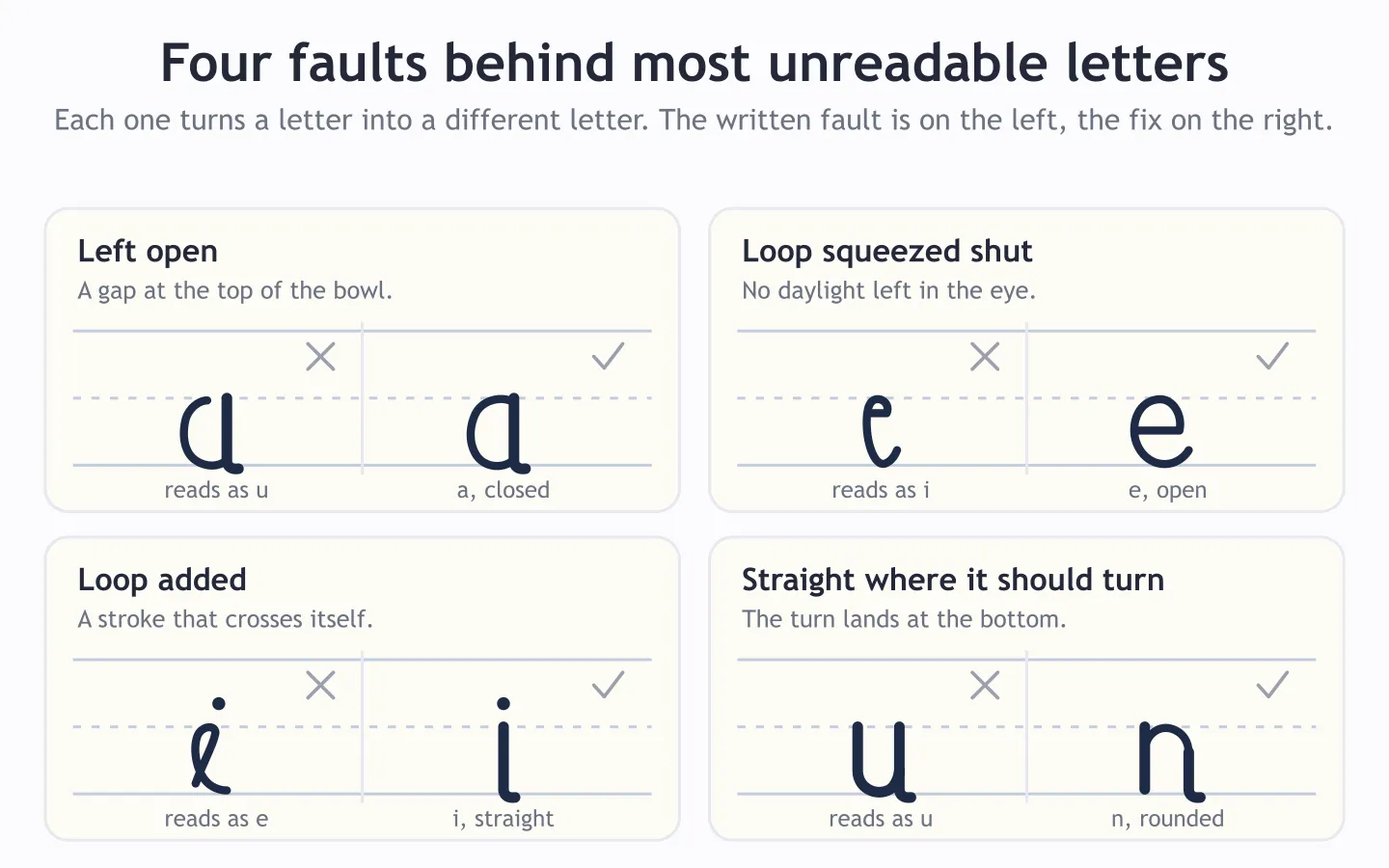
Mostly a, e, r and t. In Newland's count those four caused about 45% of illegible letters, and the worst single fault was that closed-up e. He sorted the faults into four kinds, and together they caused more than half of all unreadable writing. Each one has an obvious fix.
- Letters left open. An a or an o with a gap at the top reads as u or v. Close the circle before you move on, even if the word slows down.
- Loops squeezed shut. A closed e reads as i, a closed l reads as t. Leave enough of a gap to see daylight through the loop.
- Loops added where none belong. An i with a loop reads as e, a t with a loop reads as l. Keep the stroke straight up and straight back down.
- Straight strokes where the letter turns. An n with straight sides reads as u, an h with a straight shoulder reads as b. Round the shoulder.
Write your own alphabet out, then read it back one letter at a time with the rest covered. Any letter you can't name on its own goes on the practice list. Most people finish with four or five letters, not twenty-six.
Should I write in print or cursive?
Neither, exactly. Graham, Weintraub and Berninger collected writing from 600 students in grades 4 to 9 for a 1998 study and found the fastest writers used a mixed style, some letters joined and some printed. The samples written mostly in cursive with some print picked up the highest legibility ratings of the four styles they scored. Whatever hand you already have is likely fine. The joins are not your problem.
If you do want to rebuild a joined hand, the free cursive worksheets here print the full joined alphabet on guided rows, and our guide to hard cursive words covers the joins that fail most often.
How fast should I be writing?
Slower than you write now, at least while the shapes settle. Graham, Berninger, Weintraub and Schafer measured copying speed across grades 1 to 9 in 1998 and recorded about 24 words a minute by grade 9, with students told to write as fast as they could without errors. Treat that as a ceiling. Everyday writing sits well below it.
Speed and legibility trade against each other, and for a few weeks the trade is worth making. No study will tell you the right amount to slow down by. A workable rule: drop to a pace where you can feel yourself finishing each letter, hold it until the new shapes stop needing thought, then let the speed come back. It does come back.
Does the paper matter?
More than the pen does. Standard US ruled paper comes in three widths: wide rule at 8.7 mm between lines, college rule at 7.1 mm, and narrow rule at 6.35 mm. If your letters are cramped or your baseline wanders, move up to wide rule for a few weeks. Bigger letters are easier to steer, and a printed baseline fixes half of a poor layout score by itself.
Three-line paper adds a dashed middle line between the baseline and the top line, which gives you a reference for letter height. Schools use it to teach the difference between tall letters and small ones. It works the same for an adult whose h and n keep coming out the same size. The free lined paper printable here gives you that three-line rule.
Pens are personal, and there's no good evidence that any one type produces neater writing. Pressure is the thing to check. If your pen leaves a ridge you can feel on the back of the page, you're gripping too hard, and your hand will quit before your practice does.
How long does it take to improve handwriting?
Weeks, and fewer minutes a day than most people expect. Teresa Santangelo and Steve Graham pooled the handwriting instruction studies for a 2016 review in Educational Psychology Review and found teaching handwriting improved legibility with an effect size of 0.59 and fluency at 0.63. Those are studies of school students, so read them as evidence the skill answers to teaching, not as a promise about your own hand.
One finding in that review matters more than the headline numbers. Instruction aimed at the errors a particular writer makes scored higher, at 0.69, than general practice did. That's the case for the circling exercise above. Drilling all 26 letters when five are broken burns most of your 15 minutes on letters that were already fine.
What if it's your child's handwriting, not yours?
Then start further back. A child's messy writing usually traces to grip, hand strength, or the order the letters were taught in, and those fixes look nothing like an adult's. We have separate guides for messy handwriting at ages 6 to 8, for the tripod pencil grip, and for the stroke groups letters are best taught in. For a beginner, the name tracing generator turns any name into a traceable worksheet, which is where most kids start.
Keep the dated before-sheets. Four weeks in, the change is too small to notice day to day and hard to miss side by side.
Erstellen Sie eine Namens-Nachspur-Vorlage
Geben Sie einen Namen ein, wählen Sie eine Schrift und drucken Sie kostenlos eine Übungsvorlage.